The Geopoetics workshop series consisted of four convenings between September 2023 and April 2024. It brought together poet-scholars and early career researchers to practice geopoetics as a living methodology at the intersection of the humanities and social sciences, keeping in mind questions of epistemic justice. Across the series, participants worked with pieces of empirical data in hand (objects, transcripts, field notes, spreadsheets) through specific writing exercises and the exquisite corpse method, in order to practice collective qualitative methods. By spending time with one another’s data, participants practiced what it means to hold research as collective rather than proprietary, experimental rather than fixed, to surface new themes and conversations across datasets.
Feminists and postcolonial scholars–from Saidiya Hartman’s critical fabulation to Christina Sharpe’s atmospheric writing, Kathleen Stewart’s attunement to the ordinary–have long shown that the manner in which we gather information through the research process is not always conscious. Much happens just below the surface of awareness in the relations we establish during fieldwork.
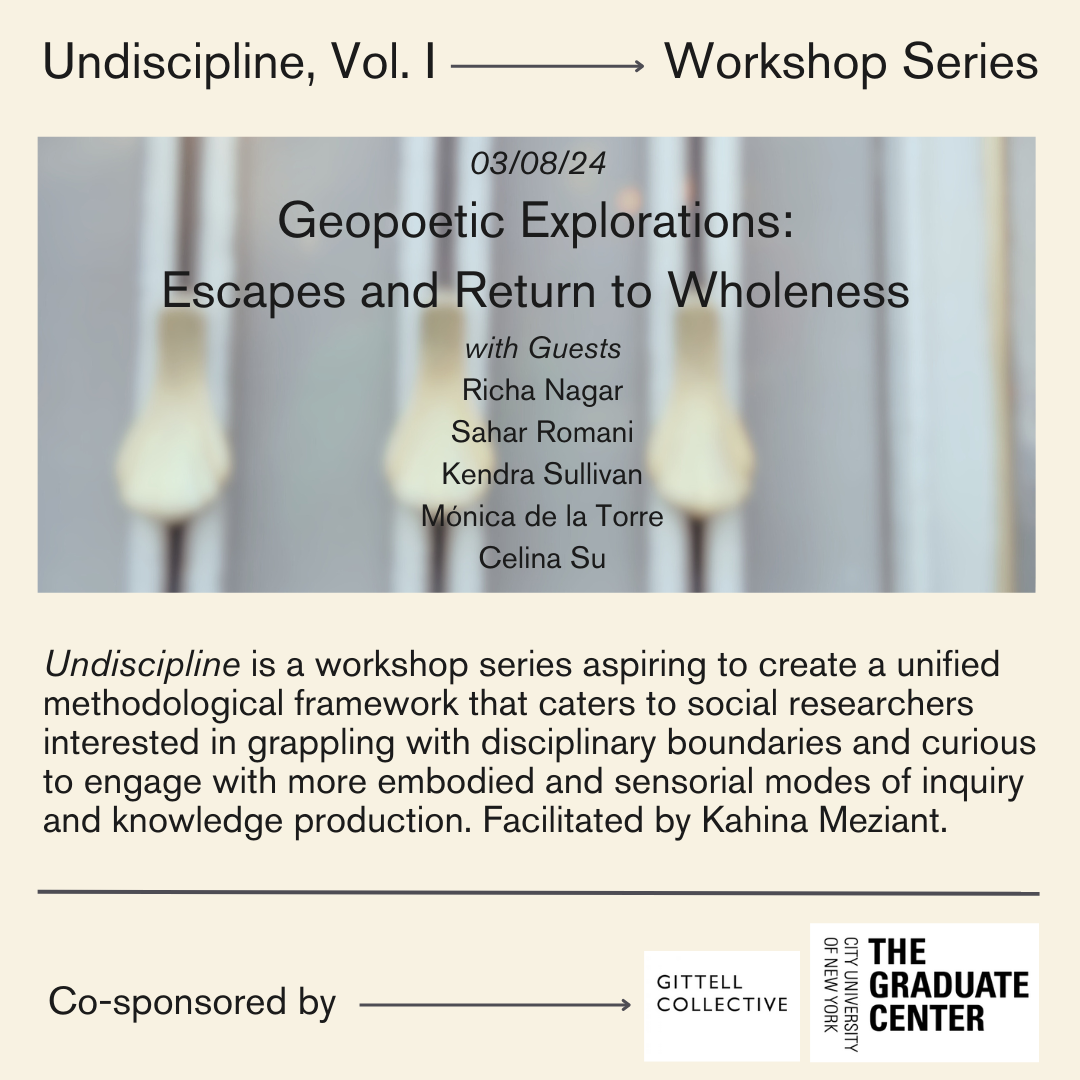
The series began in in September 2023 with an exploratory Zoom session among poet-scholars—Sahar Romani, Monica de la Torre, Richa Nagar, Celina Su, and Kendra Sullivan—working at the intersection of the humanities and social sciences with an epistemic justice orientation. By March 2024, the group reconvened in person to write with data together, treating geopoetics as affective attunement: listening across languages, disciplines, and positions, allowing multiple voices to compose what no single author could write alone.
In parallel, two additional encounters convened PhD candidates in Human Geography and Environmental Psychology interested in similar questions from within their disciplinary training—Anna Schlenz, Simone Parker, Irina Shirobokova, Clairette Atri, and Natalia Lara Gonzalez. Through collaborative mapping and creative constraints, we explored how arbitrary rules–when acknowledged rather than naturalized–can generate new ways of seeing, and how disassembling academic forms must be paired with reassembling them into something new.
The final convening in April deepened these threads around generative bounds and language as world-making, drawing on Erin Manning’s “minor gestures”—the smallest movements that transform how language is experienced and enacted. Participants proposed continued explorations of embodied methods going forward: participatory mapping, choreographic inquiry, and creative constraints as guides rather than restrictions.
 Gittell Collective