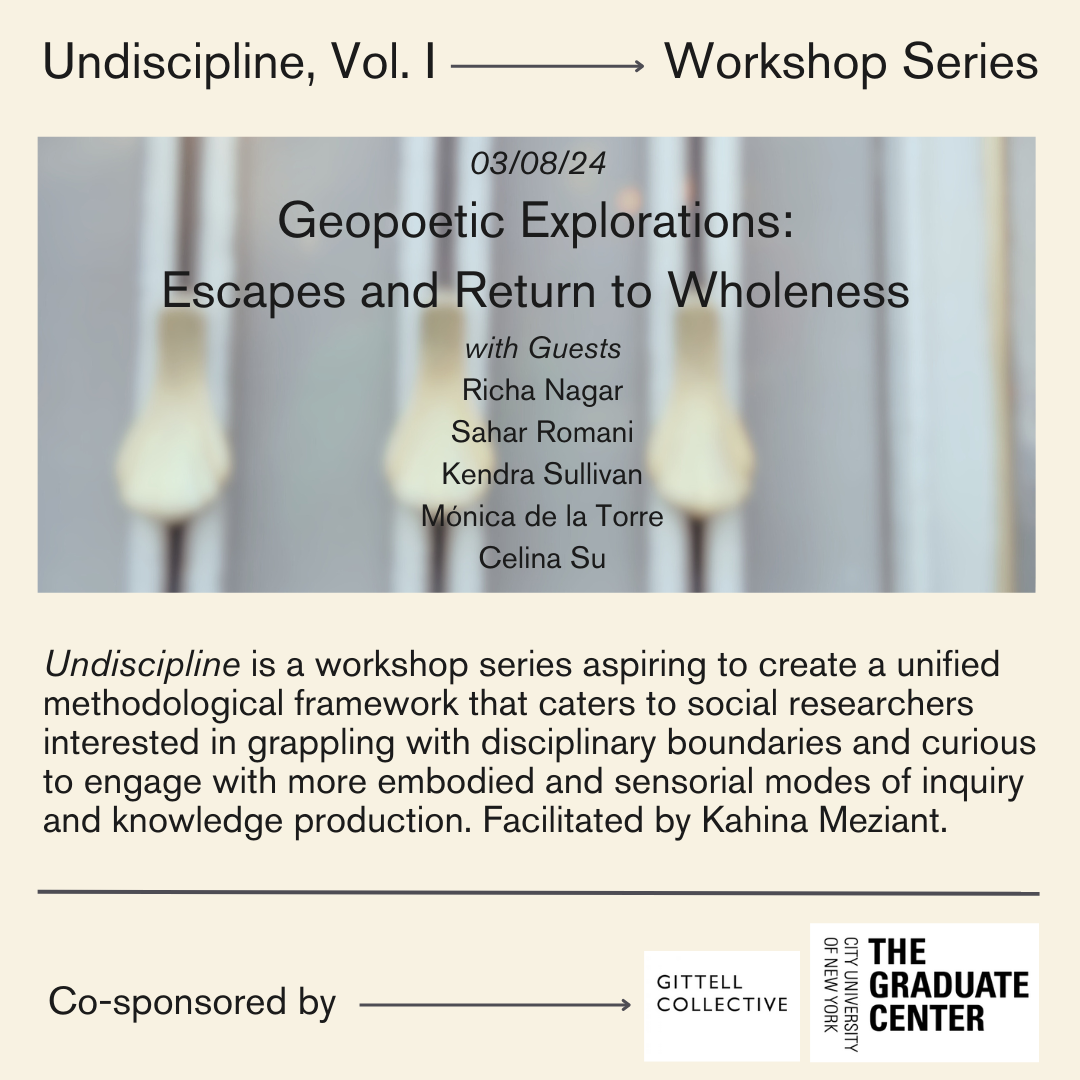
The Geopoetics workshop series consisted of four convenings between September 2023 and April 2024. It brought together poet-scholars and early career researchers to practice geopoetics as a living methodology at the intersection of the humanities and social sciences, keeping in mind questions of epistemic justice. Across the series, participants worked with pieces of empirical data in hand (objects, transcripts, field notes, spreadsheets) through specific writing exercises and the exquisite corpse method, in order to practice collective qualitative methods. By spending time with one another’s data, participants practiced what it means to hold research as collective rather than proprietary, experimental rather than fixed, to surface new themes and conversations across datasets.
Feminists and postcolonial scholars–from Saidiya Hartman’s critical fabulation to Christina Sharpe’s atmospheric writing, Kathleen Stewart’s attunement to the ordinary–have long shown that the manner in which we gather information through the research process is not always conscious. Much happens just below the surface of awareness in the relations we establish during fieldwork.
The series began in in September 2023 with an exploratory Zoom session among poet-scholars—Sahar Romani, Monica de la Torre, Richa Nagar, Celina Su, and Kendra Sullivan—working at the intersection of the humanities and social sciences with an epistemic justice orientation. By March 2024, the group reconvened in person to write with data together, treating geopoetics as affective attunement: listening across languages, disciplines, and positions, allowing multiple voices to compose what no single author could write alone.
In parallel, two additional encounters convened PhD candidates in Human Geography and Environmental Psychology interested in similar questions from within their disciplinary training—Anna Schlenz, Simone Parker, Irina Shirobokova, Clairette Atri, and Natalia Lara Gonzalez. Through collaborative mapping and creative constraints, we explored how arbitrary rules–when acknowledged rather than naturalized–can generate new ways of seeing, and how disassembling academic forms must be paired with reassembling them into something new.
The final convening in April deepened these threads around generative bounds and language as world-making, drawing on Erin Manning’s “minor gestures”—the smallest movements that transform how language is experienced and enacted. Participants proposed continued explorations of embodied methods going forward: participatory mapping, choreographic inquiry, and creative constraints as guides rather than restrictions.
The CUNY Gittell Collective is launching a second year of its Public Scholar Workshop Program. It aims to provide CUNY faculty with the support and feedback infrastructures to write and publish great first books. We acknowledge that the resources provided by book workshops– negotiated deadlines, peer camaraderie and accountability, and feedback from field/subfield experts and esteemed interlocutors– are often informally distributed, inaccessible or intimidating for scholars from historically marginalized communities, or codified and available at only certain well-resourced universities. Up to three awardees will receive support to organize a virtual book workshop in summer 2024.
A $2,800 award will be used to provide four expert reviewers an honorarium for their participation in the workshops. This workshop aims to help CUNY faculty in political science, sociology, anthropology, urban studies, and related disciplines to advance book manuscripts.
We especially encourage applications from scholars who book projects focus on issues related to cities, social justice, community participation and development, political engagement and social movements, and democratic governance, both domestically and abroad, and/or those that draw upon some aspect of community-based research and related methodologies, with the aim of combining knowledge and action for policy or social change. This program was inspired by a Book Workshop project run as a partnership between John Jay College-CUNY, Howard University, and the University of Maryland, developed by Professors Niambi Carter (UMD) and Heath Brown (JJC CUNY). This version is sponsored by the Gittell Urban Studies Collective at the CUNY Graduate Center, co-led by Drs. Celina Su and Heath Brown, and co-coordinated/organized by Dr. Kahina Meziant (kmeziant@gc.cuny.edu).
Eligibility
This workshop is designed for CUNY-affiliated faculty, whether full-time or part-time, who can share a completed draft of a first book manuscript by May 1, 2024. While applications from junior faculty (tenure-track or adjunct) will be prioritized, applications from senior faculty will also be considered if applicants 1. Wish to workshop their first book and 2. Agree to participate in a facilitated discussion mentoring junior faculty in the program.
Timeline of meetings
Awardees will meet as a cohort, to share plans for their respective book projects, in late January 2024. A second potential meeting may take place around spring break; this meeting would be an opportunity for awardees to share a portion of an introduction or a book proposal and to receive some feedback. Awardees will meet with 4 reviewers in a virtual workshop to receive feedback on their book manuscript in June 2024.
Today housing insecurity is a generalized phenomenon, driving forward policy solutions under the guise of housing for all. As many look towards the future, they’ve looked past the fight to preserve public housing in growing favor of so-called “social housing” policy solutions. This half-day mini-conference will kick off with a conversation led by tenants leading the fight to preserve public housing in New York City. After they share their analysis of the current housing climate in NYC, an international panel of housing researchers will share comparative research and perspectives on public and social housing across cities in the US, the UK, Europe, Brazil and Canada.
This event is co-sponsored by the CUNY Graduate Center Gittell Collective, the Center for Place, Culture and Politics, and the Urban Studies Department at Queens College, CUNY.
Where and when: The People’s Forum. Saturday, May 13th. 11.30-2.30 pm.
The CUNY Gittell Collective is launching its first Public Scholar Workshop Program. It aims to provide CUNY faculty with the support and feedback infrastructures to write and publish great first books. We acknowledge that the resources provided by book workshops– negotiated deadlines, peer camaraderie and accountability, and feedback from field/subfield experts and esteemed interlocutors– are often informally distributed, inaccessible or intimidating for scholars from historically marginalized communities, or codified and available at only certain well-resourced universities. Up to three awardees will receive support to organize a virtual book workshop in summer 2023.
A $2,000 award will be used to provide four expert reviewers an honorarium for their participation in the workshops. This workshop aims to help CUNY faculty in political science, sociology, anthropology, urban studies, and related disciplines to advance book manuscripts.
We especially encourage applications from scholars who book projects focus on issues related to cities, social justice, community participation and development, political engagement and social movements, and democratic governance, both domestically and abroad, and/or those that draw upon some aspect of community-based research and related methodologies, with the aim of combining knowledge and action for policy or social change. This program was inspired by the American Political Science Association’s Minority-Serving Institution Virtual Book Workshop project run as a partnership between John Jay College-CUNY, Howard University, and the University of Maryland, developed by Professors. Niambi Carter (UMD) and Heath Brown (JJC CUNY). This version is sponsored by the Gittell Urban Studies Collective at the CUNY Graduate Center, co-led by Drs. Celina Su and Heath Brown, and co-coordinated/organized by Dr. Kahina Meziant (kmeziant@gc.cuny.edu).
Eligibility
This workshop is designed for CUNY-affiliated faculty, whether full-time or part-time, who can share a completed draft of a first book manuscript by May 1, 2023. While applications from junior faculty (tenure-track or adjunct) will be prioritized, applications from senior faculty will also be considered if applicants 1. Wish to workshop their first book and 2. Agree to participate in a facilitated discussion mentoring junior faculty in the program.
Timeline of meetings
Awardees will meet as a cohort, to share plans for their respective book projects, in late January 2023. A second potential meeting may take place around spring break; this meeting would be an opportunity for awardees to share a portion of an introduction or a book proposal and to receive some feedback. Awardees will meet with 4 reviewers in a virtual workshop to receive feedback on their book manuscript in June 2023.
Facilitators: Anita Cheng, Aurash Khawarzad, and Jaime Jover.
Participants: Elizabeth Cooper, Bianca Mona, Silvia Rivera Alfaro, Anushay Said, and Joseph Torres-González.
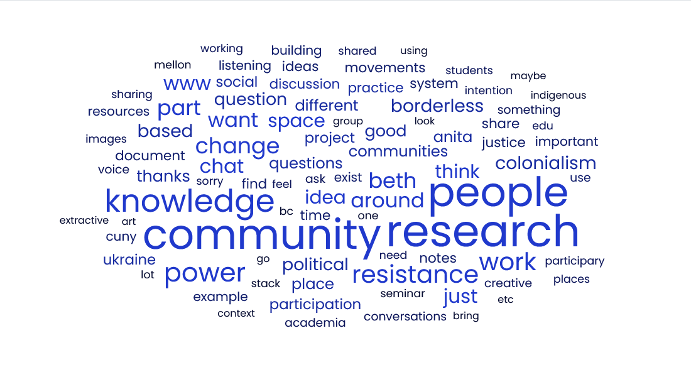
Our second iteration of the Just Research Workshop—following last year’s generative and provocative first series of workshops—brought together nine research-activists across CUNY campuses working on a wide range of community-based topics from the Arts, Anthropology, Environmental Psychology, Indigenous Studies, Geography, and Women Studies. During the four sessions over the spring 2022 semester, we worked to create a safe, horizontal environment where participants felt confident to share their views, grappling with tensions and contradictions in community-based research, grounded in specific research, creative, and pedagogical projects that we are not usually paid to tend to. We highlight here our takeaways on key, grounding concepts from our experiences together.
Word cloud.
Community and power: we work with and for community development and justice. In many ways, our commitment to “communities” can be taken for granted. Indeed, we discussed how community-based research, social practice art, etc. appear to be “hot” in academic and art worlds, but how we still lack understanding of how implement and actually realize this in substantive ways. For instance, we need to define the community we work with, so how and where do we set the boundaries? Sometimes it is clear-cut because of sociological or geographic reasons, but it also happens that it is difficult to define who belongs to a community and who does not. How does the process of self-identification work? Who commands it? This kind of conversation relates to power relations: as in every group, there are always people who hold power. As engaged scholars, especially with disadvantaged or people in need, we must distinguish who is who. As important as fighting for a community is to be aware of potential inequalities within the community.
Justice and democracy: activist-informed research is about justice in one way or another, but it is not simple to explain. We examined different conceptualizations of justice, especially as linked to honesty and equality, and also to community and democracy. But, who defines these conceptualizations? When does democratic validity lead to justice? One problem comes back to the previous point, i.e., who holds power within a community, a society? Suppose those claiming justice are not represented in the system. In that case, if they are not successful, they could rarely identify themselves with that system, and it should not surprise us if they position themselves outside of it, as non-belonging. Or in other words, if democracy does not comprise its full extension, meaning power does not reside on the people, and those on top are not accountable, it is only logical to think that some people on the bottom, the oppressed and side-lined, disassociate. In those cases, justice does not serve honesty and equality; instead, it becomes a tool against part of the community, fostering non-democratic practices like segregation and alienation. A key takeaway was the necessity to reframe justice as a crucial concept in any social formation vis-à-vis democracy, especially concerning the process by which the latter unfolds.
Reform and academia: reframing justice calls for a reformist agenda. We thought about the process, strengths, and challenges of reframing justice within current political institutions, and how most are interwoven with or embedded in notions of the Western nation-state. Reforms can be implemented at other scales of politic-economic power and outside the West, as decolonial and postcolonial theory and practice shows, in Bolivia or Chile as recent examples. Nevertheless, we wondered: do we believe in reform? Going back to the act of research, questions about positionality arose here because, as academics, we are part of institutions and within the system. Is it possible to work within a system that we do not entirely agree with and that is often unjust and unequal (to us, and especially to the communities we work with)? Are we legitimizing the system by doing so? We did not reach any consensus beyond the importance of self-awareness, uneven relations of power, and the necessity to implement community-based research methodologies that give voice to the communities in setting their agendas and goals.
Resistance: to achieve more just and equal societies we need plans that encompass both direct actions and softer reforms. How does that translate into daily practices? What does resistance look like? The communities we work with keep reframing their strategies and tactics, adjusting to their (also evolving) goals. In our discussions, it seemed helpful to distinguish the everyday emancipatory strategies we have observed as being used by BIPOC communities in the US, from the long-term, repertoires of resistance and alternative institution-building, for example, by the Zapatistas in Chiapas. Again, we could not reach a general conclusion beyond the diversities and richness of every struggle, our necessity as researchers to plug into them by active listening, putting their interest in front instead of ours.
When combined, our most fundamental learning is that our definitions of justice, democracy, and community are linked, and that many global, institutional, and personal transitions can be re-defined, re-contextualized, and understood in endless ways. These definitions are constantly changing. Thus, we must be aware of these ongoing processes and understand that the ways to research them are not fixed, but evolve together with the struggles. Through our academic activity, we are not only helping the community but also transforming their reality, for example, the ways in which they see themselves. That is to say: we need to be mindful of our impacts as academics, striving to reduce these while co-producing knowledge (theoretical and empirical) that helps the goals of the people we serve. Because it is ultimately them and the public good more broadly, and not our institutions, the reasons why we carry out research in the first place. Overall, the workshop was a helpful opportunity to share personal and professional experiences as engaged scholars, reflect on the principles that drive our activity as scholars and activists, engage in conversations about research methods, ethics, and practices, and exchange information to keep our ambitions alive for social change.
Earth and Environmental Sciences Doctoral Program Presents
Dr. Jaime Jover,Gittell Postodoctoral Fellow
For decades, economic growth in Lisbon and Seville-the third and fifth largest cities in the Iberian Peninsula-has been sustained by tourism development. When Covid-19 interrupted global mobilities, both cities’ profound dependency on tourism became evident. Instead of sparking reflection on alternatives, the pandemic reinforced a sense that tourism is the only way out of the crisis. The lecture will highlight the impacts of tourism on housing markets and unpack tourism-oriented local and regional governance in Lisbon and Seville, focusing on city strategies and urban planning in the years before and during Covid-19. A final argument centers on how tourism solidifies class structures. The goal is to question tourism as an accumulation strategy that exploits urban cultures and ask, ultimately, whether tourism can exist beyond capitalism.
April 14, 2022 4:15-6:15 p.m.
Skylight Room, 9100
The Graduate Center, CUNY
This presentation will also be accessible on Zoom. See below for Zoom Link.
Topic: Colloquium with Dr. Jaime Jover Time: April 14, 2022 04:10 PM Eastern Time (US and Canada)
Meeting ID: 811 205 1577 Passcode: EES One tap mobile +19292056099,,8112051577# US (New York) +13126266799,,8112051577# US (Chicago)
Dial by your location +1 929 205 6099 US (New York) +1 312 626 6799 US (Chicago) +1 301 715 8592 US (Washington DC) +1 669 900 6833 US (San Jose) +1 253 215 8782 US (Tacoma) +1 346 248 7799 US (Houston) Meeting ID: 811 205 1577 Find your local number: https://gc-cuny-edu.zoom.us/u/kcENI6iTsj
Fri, Mar 18, 2022 – Sun, Mar 20, 2022 Kaufman Music Center, Merkin Hall, 129 West 67th Street, Amsterdam Ave, New York, NY 10023
About the 2022 Ukrainian Contemporary Music Festival
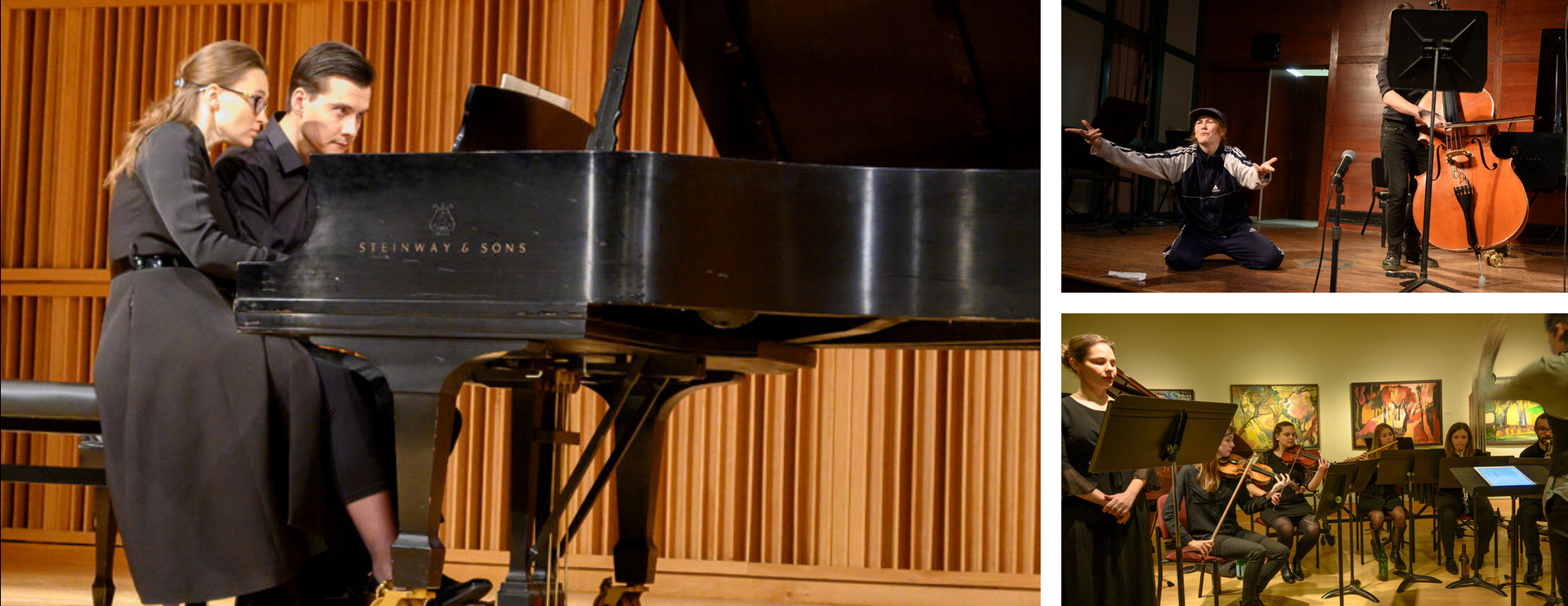
Started in 2020, the Ukrainian Contemporary Music Festival is a platform for the performance and discussion of the complex and unique contributions of Ukrainian composers to contemporary music. Through three separate concert programs and academic discussion with scholars and musicians, the festival engages the intersection of new music, contemporary events and the culture of Ukraine.
Join us for this year’s festival which will journey through the ancient Ukrainian landscape, mythologies of nature and centuries of agrarian life, to the modern city, exploring Ukraine’s diverse landscapes as we contemplate the role of music in our planet’s past, present and future.
Ukraine in 2022: UCMF Statement
While the war effort is of paramount importance, it is also crucial that Ukrainian culture does not disappear. It is the lie that Ukraine has no culture of its own that forms the basis of Vladimir Putin’s claim that Ukraine is not a proper country, a lie that has put the people of Ukraine in grave danger. UCMF 2022 will take place despite the challenges, aiming to showcase Ukrainian artists and music in a time when these matter most. So it more important than ever to give Ukrainian art and artists an international voice. Any and all acts of solidarity with Ukraine are crucial; we encourage you to support Ukrainian artists in any way you can. We are offering three performances by contemporary Ukrainian composers and artists in NYC. We invite you to join us and discover incredible music from Ukraine. Click here or below to get tickets and attend.
CONCERT SCHEDULE:
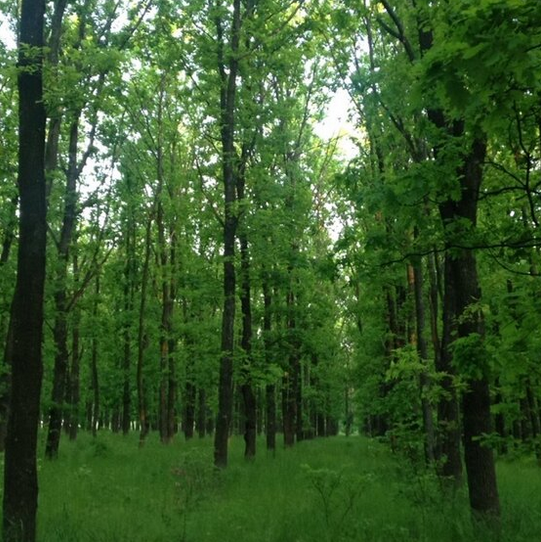
Forest Song | Лісова Пісня
Friday, March 18, 2022 at 7:00 PM. Kaufman Music Center, Merkin Hall
Photo credit: Maryna Prykhodko
Ivan Nebesnyy, Air Music 1/Wind Music
Zoltan Almashi, The echo from hitting the trunk of a dry mountain spruce in Rytsarka Hurna village
Anastasia Belitska, Rusalochka
Ostap Manulyak, Trees
—INTERMISSION—
Alla Zahaykevych, Nord/Ouest
Join us in the forest to explore a powerful source of Ukrainian traditions and mythologies. Named after Lesia Ukrainka’s poetic play, this concert reveals contemporary composers’ preoccupation with the natural world and the myths that have grown from the mysterious settings of Ukrainian forests in the North. Mixing instruments and voices with electronics, we present varied realizations of life in the woodlands. The concert culminates with Alla Zahaykevych’s sonic journey through the Polissya region, a site of feral, mystical lands, increasingly depleted since the Chornobyl nuclear disaster of 1986.
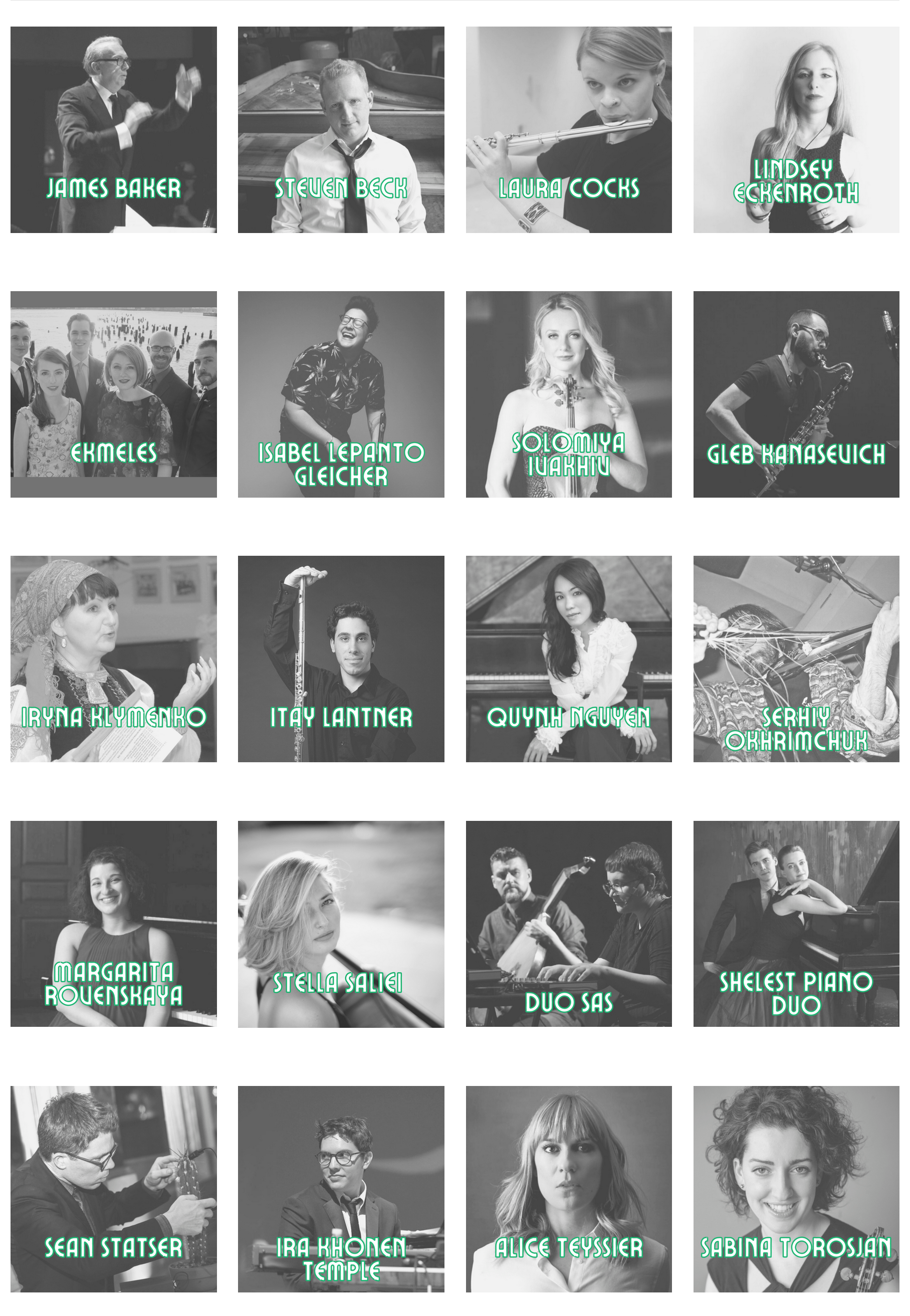
Performers include Ekmeles vocal ensemble, James Baker, Itay Lantner, Isabel Lepant Gleicher, Alice Teyssier, Laura Cocks, Gleb Kanasevich, Stella Saliei, Margarita Rovenskaya, Lindsey Eckenroth, Sean Statser and Iryna Klymenko and Serhiy Okhrimchuk of Drevo.
Saturday, March 19, 2022 at 8pm. Kaufman Music Center, Merkin Hall
Photo credit: Maryna Prykhodko
Zoltan Almashi, Carpathian Song
Yevhen Stankovych, Morning Music
Myroslav Skoryk, Hutsul Triptych
—INTERMISSION—
Improvisations and pieces by String Air Synthesis (duo SAS)
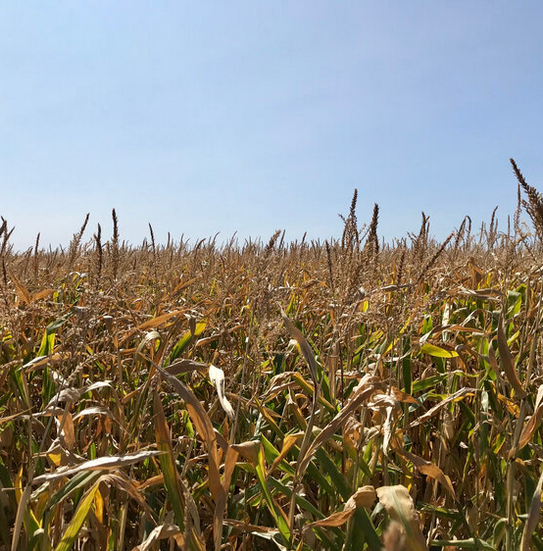
Many Ukrainian folk songs describing the facets of agrarian life begin with the “In the field…” (“Oy, u poli…”). Our second concert explores music inspired by the folk culture that accompanied centuries of rural existence. Works influenced by the Carpathian region and the traditions of the Hutsuls, an ethnographic group of Ukrainian pastoral highlanders, are are juxtaposed with the music of duo SAS, who transform elements of the same sonic world with wholly different results. Their program will include composed pieces in microtonal and even temperament for Kharkiv-style bandura and flute, with the use of extended techniques, synthesized and electronically processed sounds.
Performers include Shelest Piano Duo, Solomiya Ivakhiv, Quynh Nyugen, Sabina Torosjan, Ira Khonen Temple, and duo SAS.
Sunday, March 20, 2022 at 3pm. Kaufman Music Center, Merkin Hall
Photo credit: Maryna Prykhodko
Alexey Shmurak, Greenland
—INTERMISSION—
Roman Grygoriv and Illia Razumeiko, Chornobyldorf Partita
Our final concert interrogates the destructive consequences of human exploitation of the Earth, moving from the land as a site of magic and abundance to one of damage and devastation. Alexey Shmurak’s Greenland sheds a reflective light on the erosion of the Arctic, while the Chornobyldorf Partita by Roman Grygoriv and Illia Razumeiko imagines life in a post-apocalyptic world.
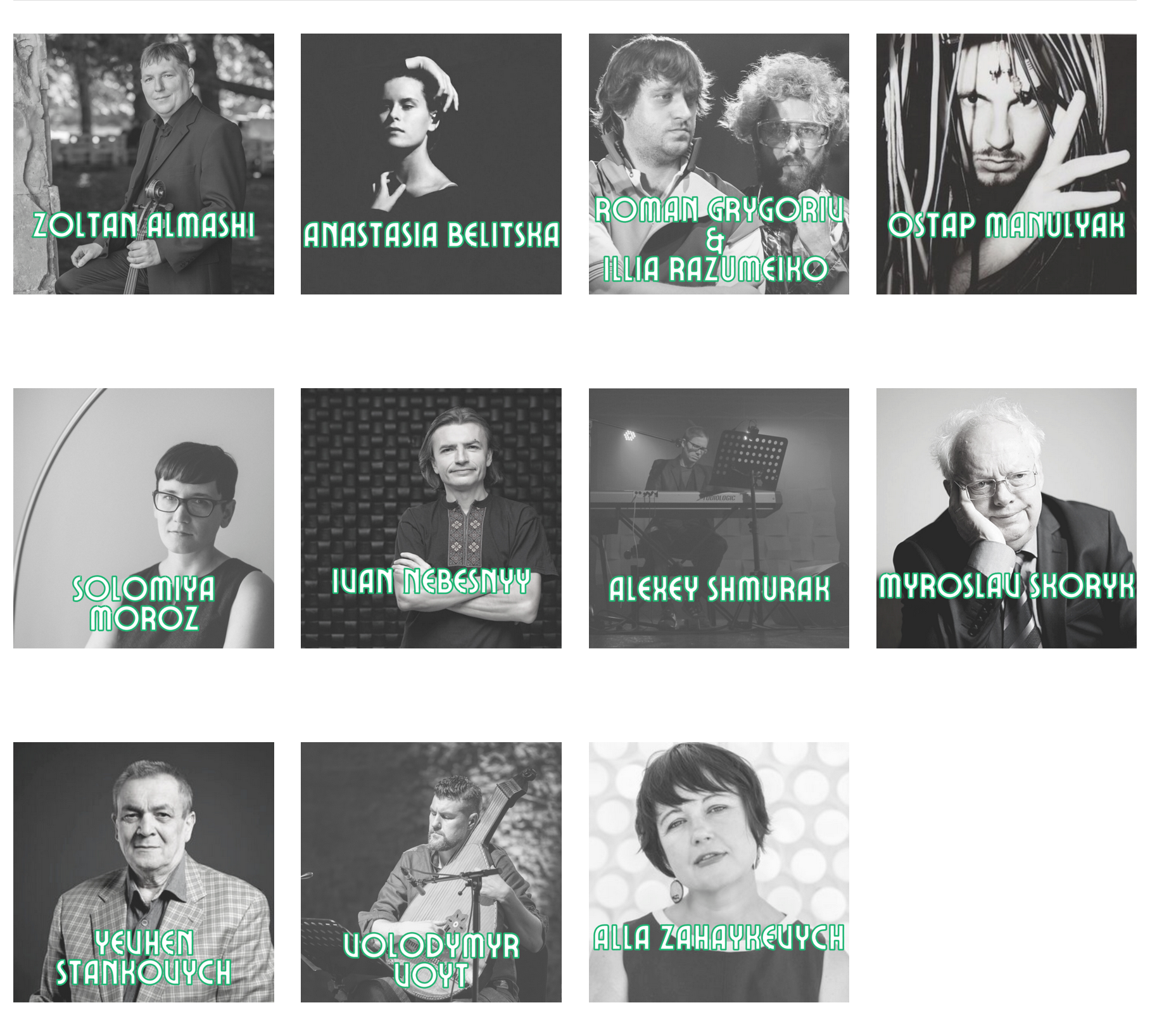
Click here or below to see the full list of composers.
PERFORMERS
Click here or below to see the full list of performers.
Click here for the official 2022 Ukrainian Contemporary Music Festival website and more information, including performers, composers, video recordings, photos, past events, media, partners and more. The Center for the Humanities at the Graduate Center, CUNY and the CUNY Adjunct Incubator with the Gittell Urban Studies Collective are proud co-partners and supporters of the Ukrainian Contemporary Music Festival organized by Leah Bastone.
Read “Surveying Ukraine’s Musical Landscape: 2020 to 2022” in anticipation of the 2022 Festival from organizer and creative director Leah Batstone who offers an update on Ukraine’s musical landscape since the inaugural Ukrainian Contemporary Music Festival in 2020.
The Center for the Humanities at the Graduate Center, CUNY and the CUNY Adjunct Incubator with the Gittell Urban Studies Collective are proud co-partners and supporters of the Ukrainian Contemporary Music Festival organized by Leah Bastone (Hunter College, CUNY).
Statement from the organizer: “As a musicologist, my research is rooted in intersections of music and politics. I am interested in music’s response to political change and its role in mediating philosophical ideas, particularly its relationship to Leftist discourses, the history of socialism in the 20th century, and challenges to narratives of hegemonic cultures. The Ukrainian Contemporary Music Festival grew out of a project I conducted examining how musical programming had changed in Ukraine following the 2014 Revolution of Dignity. It has continued to serve as a site to investigate the newest music and composers from Ukraine as well as to examine their works as part of a longer history of Europe’s largest country. The geopolitical circumstances coinciding with this year’s festival make the need to highlight the anti-imperial narratives of Ukrainian music even more relevant and urgent.”
“Just Research: Study, Struggle, Solidarity” is a short workshop series on conducting public scholarship and democratizing the production of knowledge.
Building on the first Just Research series in the spring of 2021, this workshop takes place over 4 weeks, provides $500 as an honorarium upon completion, and is specifically tailored for adjunct instructors in the humanities and humanistic social sciences.
This workshop series aims to help CUNY Adjuncts to advance research projects (including but not limited to dissertations) that draw upon some aspect of Community-Based Research and related methodologies, such as Participatory Action Research, Collaborative Inquiry, and Practice-Based Research. Such research tackles community problems, with the aim of combining knowledge and action for policy or social change.
The workshop series will focus on
1. skills and strategies for participating effectively in such research,
2. navigating issues of rigor and validity in such work,
3. developing appropriate research strategies and outlines of presentations/ articles/ chapters for dissemination, and
4. building structures of support and room for reflexive work along the way.
Throughout the series, we will also prioritize our meetings as opportunities to broach typically overlooked or sensitive topics, to share concerns or reservations as well as aspirations related to our work, to support one another and make real progress on our respective projects, and to collectively share insights on negotiating academic milestones, disciplinary boundaries, and austerity in collaborative research.
This course aims to facilitate multi-disciplinary dialogues on theories and principles of community-based research (with special attention to race, gender, and class dimensions), the strengths and limitations of such approaches, and guiding practices and case studies/ models for successful research projects. We have designed this series to support and strengthen the significant scholarly, creative, and pedagogical work of adjuncts teaching in the humanities and humanistic social sciences across CUNY.
Eligibility:
CUNY Adjuncts: This workshop is designed for CUNY-affiliated adjuncts/ researchers, who have already formulated at least an idea for a research project. We aim to think through and reflect upon research projects that center on the complexity of real-life sociopolitical contexts and struggles, and implications and impact upon people on the ground (alongside theoretical models and debates in academic literatures). We particularly encourage previous applicants to the CUNY Adjunct Incubator program to apply to participate in this workshop series, regardless of whether their applications were successful and received funding.
For CUNY Students: Before applying, please contact the office of financial aid at your campus to ensure that you are eligible to receive this funding without it adversely impacting your existing financial aid package. In your email to them, please include the fellowship amount, the semester you would receive it, and your EMPL ID, which you can find in CUNYFirst under Student Center.
At this time, we are able to provide a $500 honorarium for each participant upon completion of the workshop series.
Time commitment:
This workshop series is designed to require 4 hours of participation each week, comprising of roughly 2-3 hours of preparatory work and a 1.5-hour meeting each week.
Schedule: Fridays, 10:30 am -12:00 pm (Dates: 3/11, 3/18, 3/25, and 4/1)
How and why did we develop this workshop series?
This workshop series builds upon last year’s Just Research workshop series, which in turn followed the success of the CUNY Adjunct Incubator, a collaborative effort between the Gittell Collective and Center for the Humanities Mellon Foundation-funded Seminar on Public Engagement and Collaborative Research. The Adjunct Incubator project advocates to improve the material conditions of university life and make them more equitable for adjuncts, by supporting the significant scholarly, creative, and pedagogical work of adjuncts teaching in the humanities and humanistic social sciences across CUNY. Providing social, logistical, financial, and professional support for the creation and circulation of knowledge by CUNY adjuncts, this platform promotes the crucial work of part-time faculty across the CUNY community and senior college campuses.
We were struck by the immense interest in urgent, action-oriented public scholarship among adjunct instructors throughout the CUNY campuses. We developed this workshop series after noting the dearth of courses that emphasize (or even mention) participatory methods and methodologies in social research and the public humanities at the CUNY Graduate Center. Of particular importance is the centrality of ethics and the obligations of public university in anti-racist solidarities and public scholarship.
The first workshop series was led by Professor Celina Su (Environmental Psychology and Urban Education, director of the Gittell Collective) and Kendra Sullivan (Associate Director, Center for the Humanities). This year will be led by Jaime Jover (Gittell Postdoctoral Fellow in Urban Studies, Environmental Psychology Program at the Graduate Center), Anita Cheng (Film and Media Department at Hunter College & Art Department at Brooklyn College) and Aurash Khawarzad (Earth and Environmental Sciences at the Graduate Center), who participated last year.
+++
Syllabus
1st session. March 11, 2022. Unpacking the roots and uses of participation in research
Overview: the session will cover why is worth using participatory methods, discuss different approaches and how to select and adjust them depending on our research proposal, and how to navigate questions of positionality and ethical dilemmas that may come up. Readings:
Cornwall, Andrea. 2008. Unpacking ‘Participation’: Models, Meanings, and Practice. Community Development Journal, 43:3, pp. 269–283.
Appadurai, A. 2006. The Right to Research. Globalisation, Societies and Education, 4:2, pp. 167-177.
Pulido, L. FAQs: Frequently (Un)Asked Questions about Being a Scholar Activist, pp. 341-365, in Hale, Charles, ed., Engaging Contradictions.
2nd session. March 18, 2022. Articulating Methodologies: Positionality statements, framework decision making and how identity informs
Overview: How do we go about this? How do we select specific methods that help us to connect relevant theories and research questions to communities on the ground, and what we are ultimately interested in learning about? How do we articulate our positionalities using these methods?
Stoecker, R. 1999. Are academics irrelevant? Approaches and roles for scholars in Community-Based Participatory Research. American Behavioral Scientist, pp. 840-854.
Hale, Charles, ed., Engaging Contradictions. [See pp. 370-394 of Hale PDF.]
Cairns, K. 2011. Ethnographic locations, Chapter 3 of dissertation.
3rd session. March 25, 2022. Revolutionary democratic people’s planning – escape routes from the capitalist endgame.
Overview: This session will explore concepts of justice, sustainability, fulfillment, and more, as they relate to the ability of communities to appropriate, construct, and protect their own real-world environments. Additionally, we will explore methods for grassroots research, planning, and design, and models for partnership between academia and local action-research projects.
Brown, Wendy. In the Ruins of Neoliberalism: The Rise of Antidemocratic Politics in the West (Pages 24 – 39). July 16, 2019.
Meek, David. “Cracks in the Wall of Capitalism: The Zapatistas and the Struggle to Decolonize Science”. February 26, 2018.
4th session. April 1, 2022. Participants project’s presentation & final discussion
This workshop series is organized and co-sponsored by the Gittell Collective and Center for the Humanities Mellon Foundation-funded Seminar on Public Engagement and Collaborative Research.
Join the Center for the Humanities for a showcase of creative and innovative community-based projects and research developed from several different public humanities initiatives by students and scholars at CUNY.
Over two lunchtime sessions, Fellows from Humanities New York, the Mellon Seminar on Public Engagement and Collaborative Research, and recipients of the CUNY Adjunct Incubator will present their unique projects that combine digital and community engagement with artistic and academic methodologies. Join us Thu, Dec 9th at 12:30 for the second showcase focusing on community education and public learning projects.
Read about each student fellow or scholar, their public humanities projects, and the initiatives they stem from in detail below:
Tania Avilés Vergara (CUNY Adjunct Incubator recipient, is a PhD candidate in Latin American, Iberian, and Latino Cultures, Hispanic Sociolinguistics track, at the Graduate Center, CUNY, and adjunct professor at Lehman College)
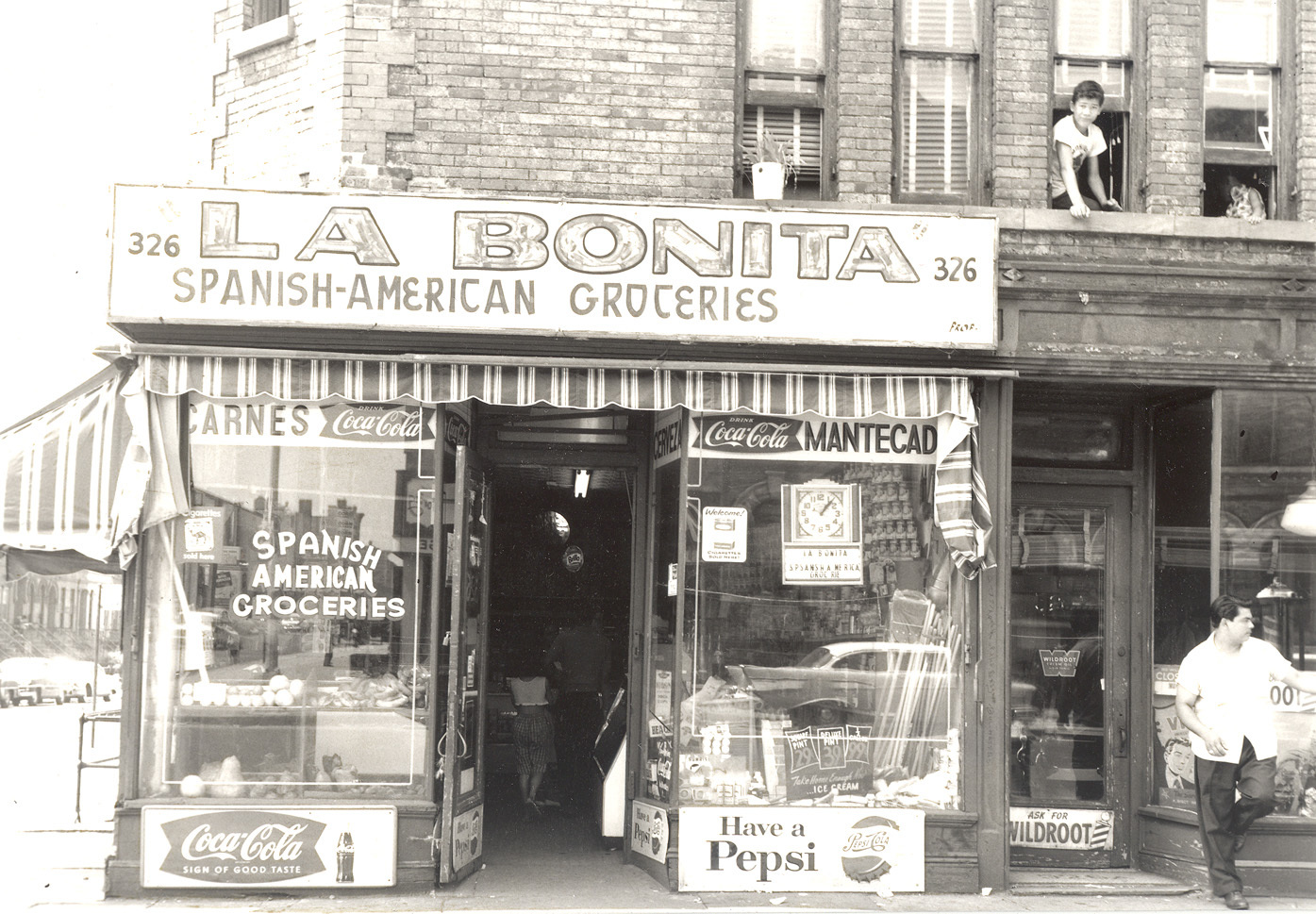
Project: Teaching and Learning Spanish at CUNY: Public Language Education Through Archival Resources advocates for the use of archives as open educational resources in the Spanish language class, in order to ground second language learning within the historical, social and linguistic experiences of CUNY students, and partners with CUNY archival institutions such as the Center for Puerto Rican Studies, the Dominican Studies Institute and the Mexican Studies, promoting their collections and educational programs in the classroom.
Image courtesy of the Collection The Bodega: A Cornerstone of Puerto Rican Barrios at the Center for Puerto Rican Studies Library & Archives. Hunter College, City University of New York.
Mariposa Fernandez (CUNY Adjunct Incubator recipient, teaches at the Herbert H. Lehman College in the Women and Gender Studies Program and the Africana Studies Department, as well as the Black Studies Program at The City College of New York)
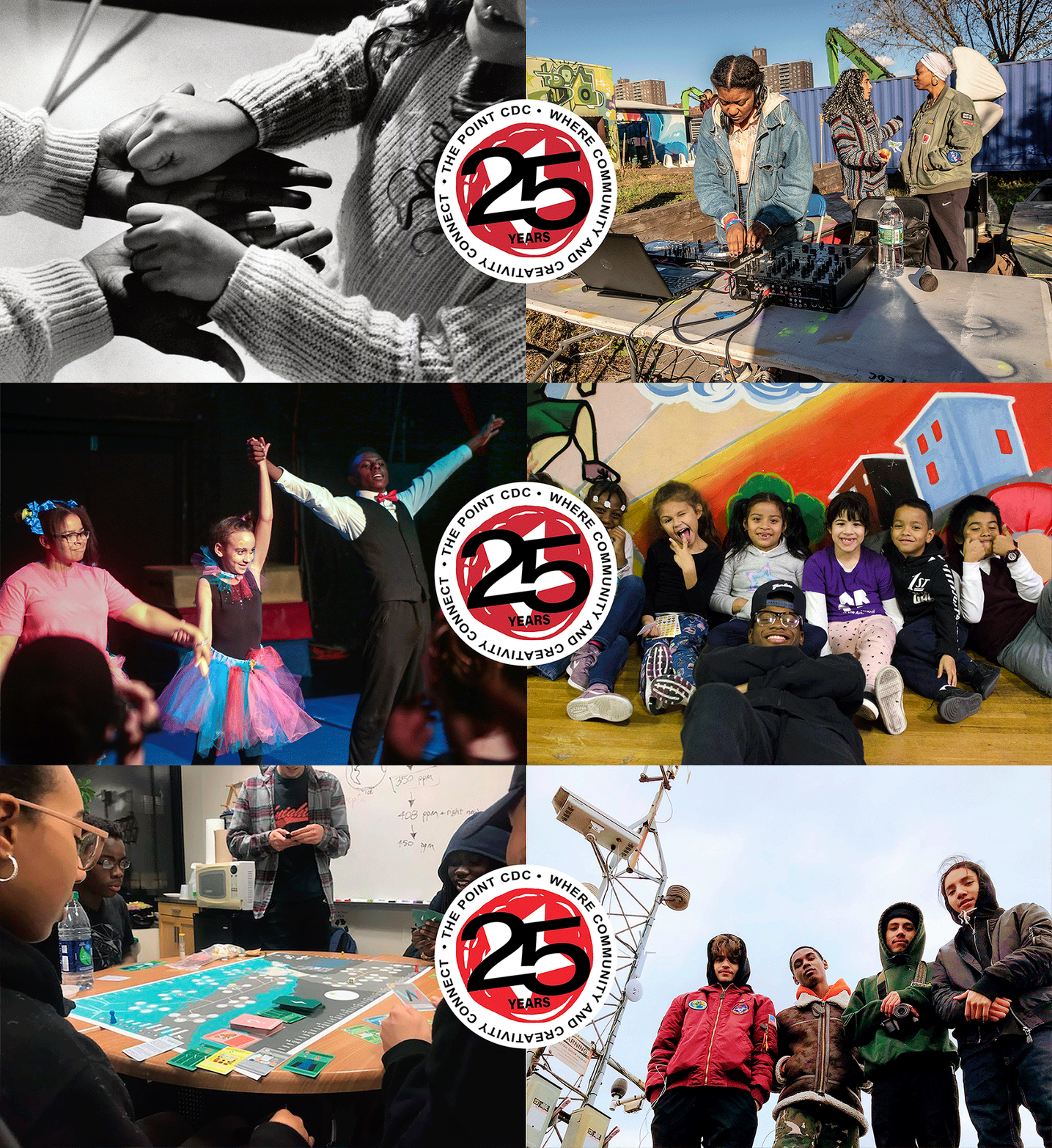
Project: The Be A Buddy (BaB) Multimedia Project: Stories of Strength from the South Bronx aims to document community and neighborhood resilience by gathering stories of strength in the South Bronx (using photography and digital technology to document oral interviews, and offering free creative writing workshops) and explore the impact and effectiveness of THE POINT CDC’s mutual aid projects and the community building efforts of neighbors taking care of each other from 2018 to the present pandemic.
THE POINT CDC’s mutual aid projects and the community building efforts
Kendra Krueger (CUNY Adjunct Incubator recipient, Advanced Science Research Center, The Graduate Center, CUNY)
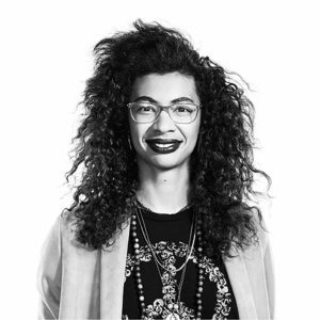
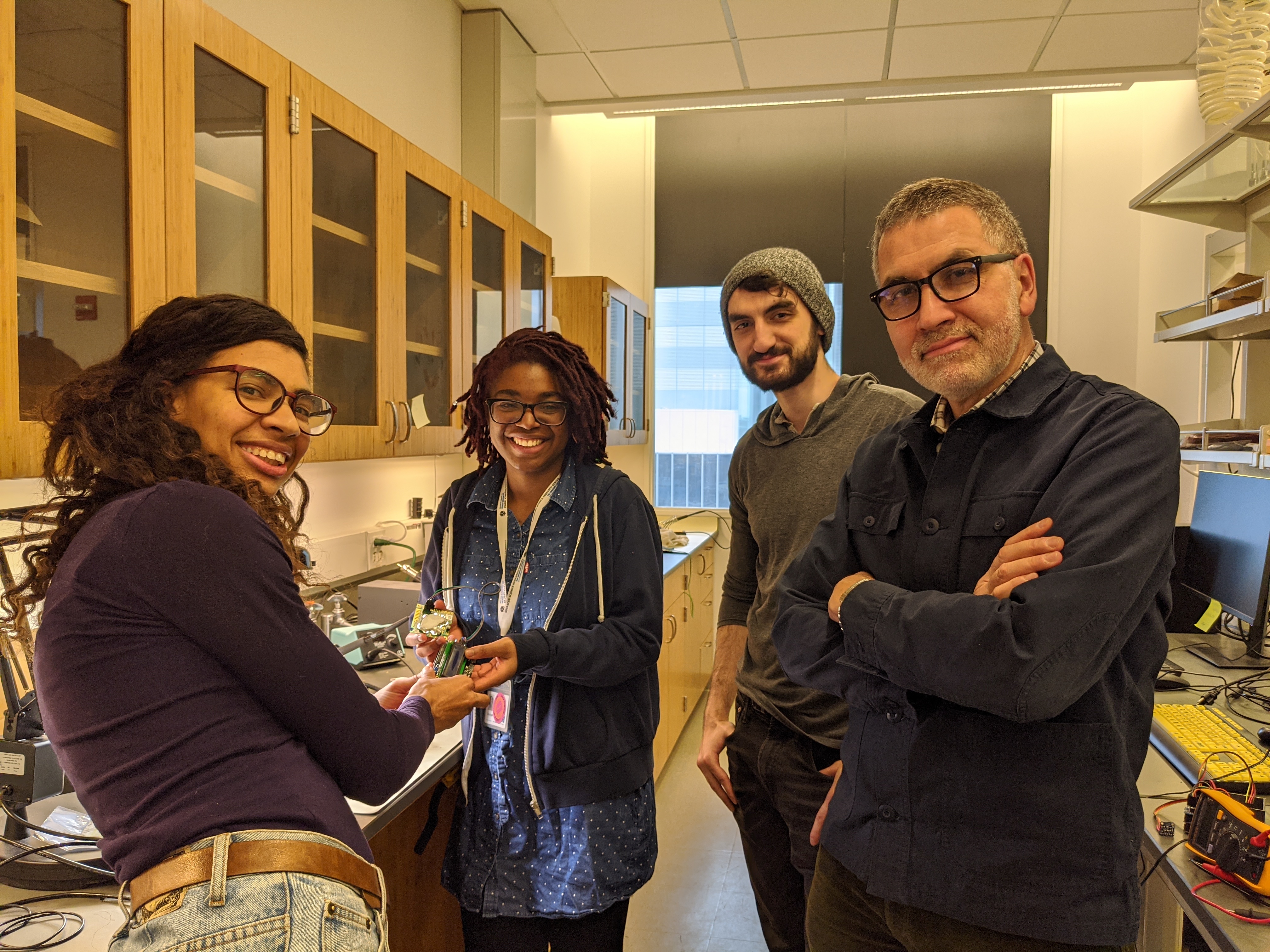
Project: The Community Sensor Lab is a space for DIY community science and advocacy which seeks to equip youth and community members with research tools and STEAM skills to better advocate for local policy change on public health and environmental justice.
Kendra Krueger (left) and Ricardo Toledo-Crow (right), co-founders of The Community Sensor Lab, work with CUNY students Samaiyah Morgan (Laguardia Community College) and Peter Christakos (City College of New York) as part of the ASRC’s Community Sensor Lab.
Luke Elliott-Negri (Humanities NY Fellow and a PhD student in the Sociology Program at The Graduate Center, CUNY)
Project: Human Politics seeks to humanize and demystify politics, politicians, and political decision-making through short interviews (typically just 10 minutes) with individuals who are, broadly defined, politically active.
Michelle Gaspari (CUNY Adjunct Incubator recipient, PhD student in Cultural Anthropology at The Graduate Center, CUNY, an Adjunct Lecturer in Sociology, Anthropology, and Women and Gender Studies at Baruch College, and a Co-Organizer at The CUNY Adjunct Project)
Project: The Adjunctification of Higher Education: A Guided Syllabus is a multimedia digital pedagogical toolkit for faculty to teach about adjunct welfare and precarity at CUNY.
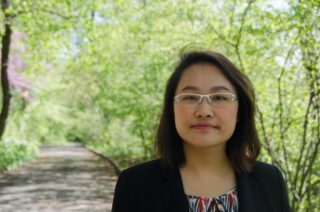
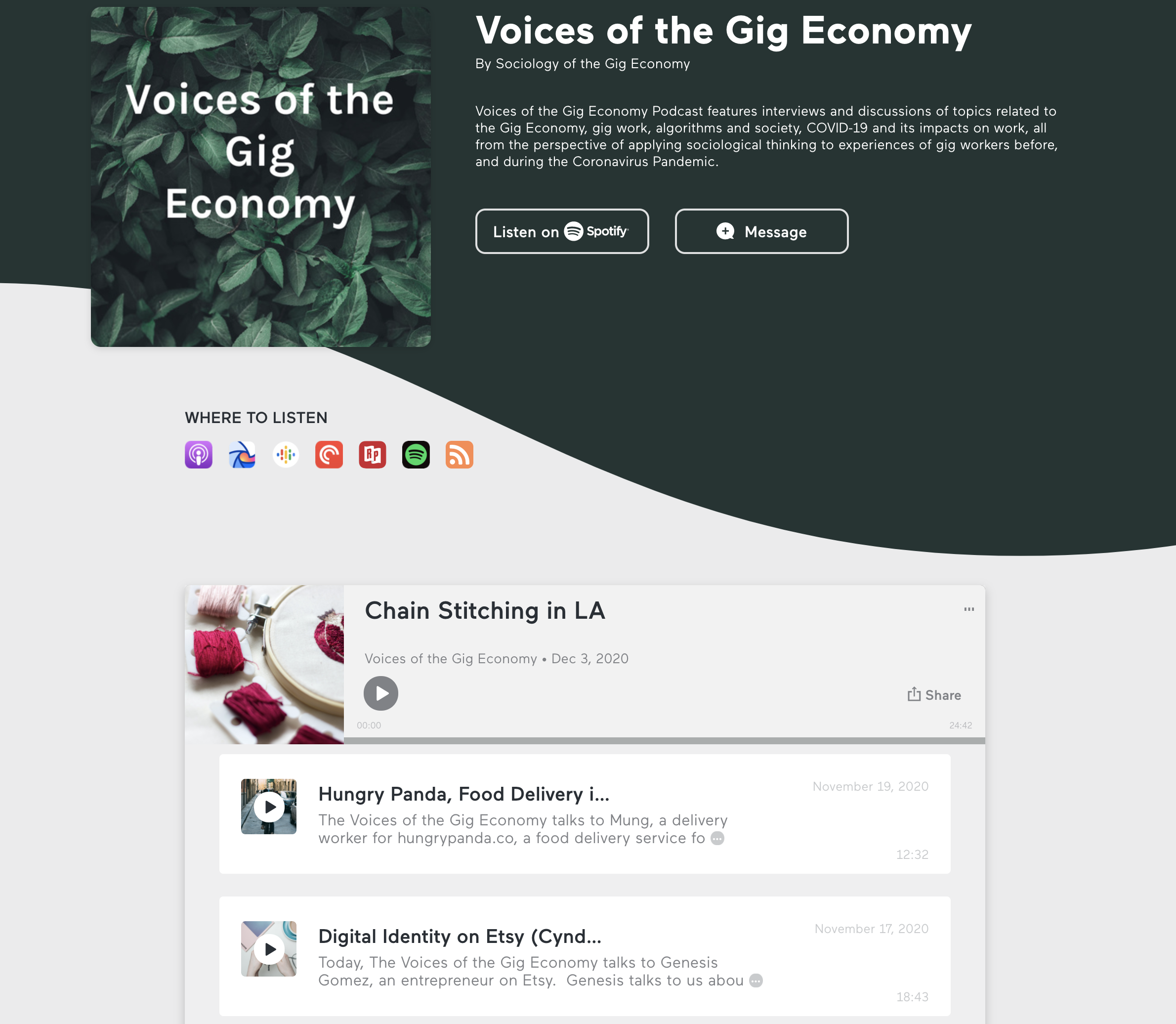
Nga Than (Digital Publics Fellow for the Seminar on Public Engagement and Collaborative Research and doctoral candidate in the Sociology Program at The Graduate Center, CUNY) Project: Voices of the Gig Economy is a podcast created and curated by students of the Sociology of the Gig Economy course at Hunter College, Fall 2020. Students interviewed gig economy workers and asked them about their lived experience during the COVID-19 Pandemic. Through the lens of the workers, students were able to explore complex relationships between work, technology, and society.
About These Initiatives:
Cuny Adjunct Incubator: is a framework for supporting the significant scholarly, creative, and pedagogical work of adjuncts teaching in the humanities and humanistic social sciences across CUNY. Providing social, logistical, financial, and professional support for the creation and circulation of knowledge by CUNY adjuncts, this platform promotes the crucial work of part-time faculty across the CUNY community and senior college campuses. Sponsored by the Center for the Humanities and the Gittell Urban Studies Collective at The Graduate Center, CUNY. Mellon Seminar on Public Engagement and Collaborative Research: is an interdisciplinary platform for creative, activist, and scholarly collaboration that supports humanistic research, teaching, and activities with social justice aims. Working with a cohort of faculty, graduate and undergraduate students, and community partners, the project opens up and democratizes knowledge production, supports civic and community engagement, and connects classrooms, CUNY campuses, and the city of New York.
Public Humanities Fellowship with Humanities New York: offers advanced humanities graduate students a chance to explore the public application of their scholarly interests, including training in the methods of the public humanities, networking, and professional development. Each Fellow in the cohort of 18 designs and implements a public humanities project in collaboration with a community-based partner.
This event is co-sponsored by the Center for the Humanities and the Gittell Urban Studies Collective at The Graduate Center, CUNY, and Humanities NY.




 Kendra Krueger (left) and Ricardo Toledo-Crow (right), co-founders of The Community Sensor Lab, work with CUNY students Samaiyah Morgan (Laguardia Community College) and Peter Christakos (City College of New York) as part of the ASRC’s Community Sensor Lab.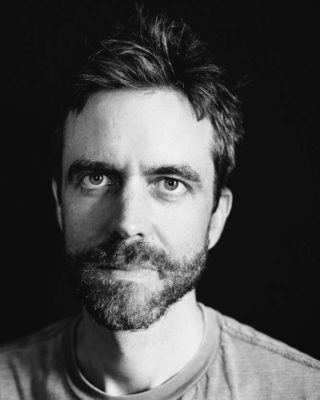

 Gittell Collective