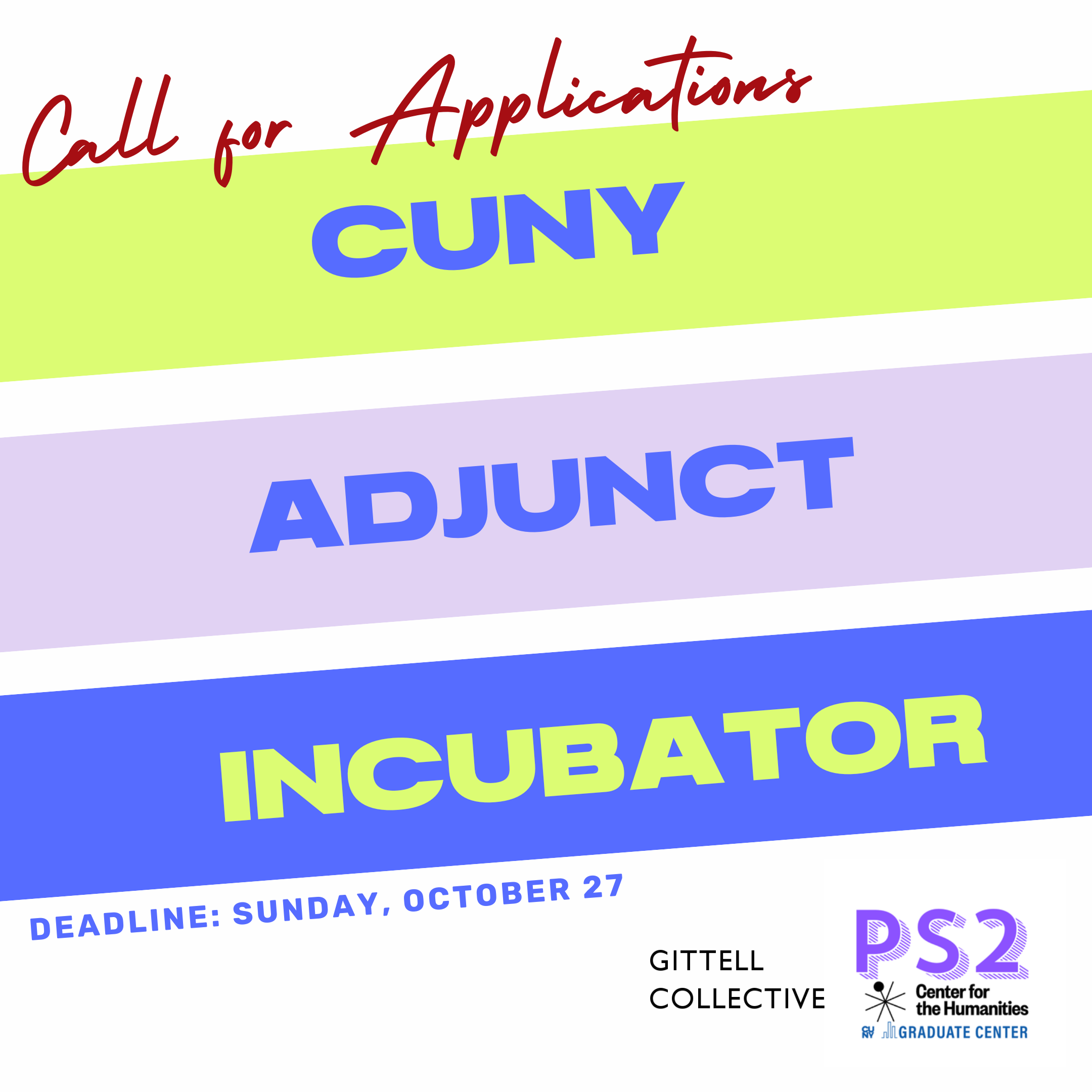
CALL FOR APPLICATIONS: 2025 CUNY Adjunct Incubator Grants

The CUNY Adjunct Incubator supports and highlights the significant, critical and community-engaged scholarship and pedagogy work of adjuncts teaching across CUNY. Co-sponsored by the Public Scholarship Practice Space (PS2) housed at the Center for the Humanities and the Gittell Urban Studies Collective, the Adjunct Incubator aims to:

  • Call public attention to adjuncts’ valuable contributions at CUNY;
  • Support CUNY adjuncts and their teaching, scholarly, creative, and activist work;
  • Promote their arc toward professional success and economic well-being; and
  • Advocate for more paid, full-time, tenure-track positions for adjuncts to advance toward.

We will award $4,000 each to ten CUNY adjuncts developing independent scholarship and/or public projects in the humanities or humanities-related social sciences. Scholarship and/or public projects to be completed during the summer of 2025. 

DEADLINE:

Sunday, October 27, 2024 by 11:59 pm

WHAT:

For this cycle, we wish to prioritize community-facing and -building work, broadly construed. Project focus might include (but not limited to): public education (especially CUNY), public health, housing, labor, liberation movements.

Our rubric for evaluation is as follows:

  1. Public engagement: Does this project demonstrate a deep awareness of the reciprocal methods, ethics, and goals of community-oriented practice? Does it consider the compensation of communities in which it engages, and provide a robust grasp of existing research and genealogies of its subject of study?
  2. Urgency: Does this project address an emergent social (environmental, health, educational, etc.) need in meaningful ways?
  3. Creativity: Does the application think about an intellectual or practical problem through a previously unexamined perspective or with an innovative set of tools?
  4. Feasibility: Does the project seem manageable and are we the right organization to help the applicant fulfill their goals in a rich and nuanced way?

In addition to covering costs associated with scholarly research, this grant can support travel related to professional and/or curriculum development, and research and development of a public-facing project such as: archival research, oral histories, digital/interpretative platforms, online or print publications, performances, and panels, conferences, and exhibitions, etc. The scholarship work and/or public projects are to be completed during the summer of 2025. For examples of past grant-funded projects, visit 2021 projects here, 2020 projects here, and 2019 projects here):

ELIGIBILITY:

Current adjuncts at any CUNY College.

*Please note that if you are a current doctoral fellow at The Graduate Center, CUNY who also holds adjunct position/s, before applying, please contact the Office of Financial Aid at financialaid@gc.cuny.edu  to ensure that receiving this grant will not adversely impact your existing award package.

EXPECTATIONS:

  • You will be in charge of managing your research or project, from conception to completion. This includes managing the budget e.g. honoraria for community participants and others, and any taxes i.e. deduct 33%
  • We request a blog post about your project and a brief, one-page, narrative report on research progress and impact by September 12, 2025. 
  • We invite recipients to think about sharing their work with wider publics and welcome proposals for public panels or online events related to your work.

APPLICATION:

Fill out the application form, and upload as a single PDF file to the form (name your file as follows LASTNAME_FIRSTNAME_CAI2025):

  1. a one-page letter of interest (which can include a description of your research or public project, a timeline, and your methodological tool-kit),
  2. CV,
  3. a brief, budgetary outline.

Questions? Please reach out to us ps2@gc.cuny.edu

SELECTION PROCESS: 

Recipients will be decided by an interdisciplinary advisory committee. The 2025 CUNY Adjunct Incubator Advisory Committee is comprised of Celina Su, Dasharah Green, Kendra Sullivan, Mary N. Taylor, Prithi Kanakamedala, and Ujju Aggarwal.

For any queries, reach out to Prithi, PS2 faculty coordinator ps2@gc.cuny.edu

The CUNY Adjunct Incubator is co-sponsored by PS2 at the Center for the Humanities through generous grants from the Sylvia Klatzkin Steinig Fund and the Gittell Urban Studies Collective at the Graduate Center, CUNY.

About the Gittell Urban Studies Collective: The Gittell Urban Studies Collective engages communities, fellow scholars, and activists focused on issues related to cities, social justice, community participation and development, political engagement and social movements, and democratic governance, both domestically and abroad. Read more here

About the Center for the Humanities at The Graduate Center, CUNY: The Center for the Humanities at the CUNY Graduate Center encourages collaborative, creative, and engaged work in the humanities and social sciences. While providing students, faculty, and community partners with grants, fellowships, and professional support, we also produce innovative projects and programs, digital and print publications, and infrastructure for public scholarship from a justice-forward framework at CUNY and across NYC.  Read more here.
2024 Dissertation Fellows

We are pleased to announce the 2024 Gittell Dissertation Fellows:

Ryan Brunette (Political Science), After the Miracle: Constructing Political Regimes and Corruption in Post-Apartheid South Africa 

Thayer Hastings (Anthropology), Inhabiting the “Center of Life” in Jerusalem and the Demographic Governance of non-Citizenship

Zahra Khalid (Earth and Environmental Sciences), The “military real-estate state:” insecurity, middle-class aspirations, and speculative real-estate development in Pakistan

Geopoetics workshop series

The Geopoetics workshop series consisted of four convenings between September 2023 and April 2024. It brought together poet-scholars and early career researchers to practice geopoetics as a living methodology at the intersection of the humanities and social sciences, keeping in mind questions of epistemic justice. Across the series, participants worked with pieces of empirical data in hand (objects, transcripts, field notes, spreadsheets) through specific writing exercises and the exquisite corpse method, in order to practice collective qualitative methods. By spending time with one another’s data, participants practiced what it means to hold research as collective rather than proprietary, experimental rather than fixed, to surface new themes and conversations across datasets.

Feminists and postcolonial scholars–from Saidiya Hartman’s critical fabulation to Christina Sharpe’s atmospheric writing, Kathleen Stewart’s attunement to the ordinary–have long shown that the manner in which we gather information through the research process is not always conscious. Much happens just below the surface of awareness in the relations we establish during fieldwork.

The series began in in September 2023 with an exploratory Zoom session among poet-scholars—Sahar Romani, Monica de la Torre, Richa Nagar, Celina Su, and Kendra Sullivan—working at the intersection of the humanities and social sciences with an epistemic justice orientation. By March 2024, the group reconvened in person to write with data together, treating geopoetics as affective attunement: listening across languages, disciplines, and positions, allowing multiple voices to compose what no single author could write alone.

In parallel, two additional encounters convened PhD candidates in Human Geography and Environmental Psychology interested in similar questions from within their disciplinary training—Anna Schlenz, Simone Parker, Irina Shirobokova, Clairette Atri, and Natalia Lara Gonzalez. Through collaborative mapping and creative constraints, we explored how arbitrary rules–when acknowledged rather than naturalized–can generate new ways of seeing, and how disassembling academic forms must be paired with reassembling them into something new.

The final convening in April deepened these threads around generative bounds and language as world-making, drawing on Erin Manning’s “minor gestures”—the smallest movements that transform how language is experienced and enacted. Participants proposed continued explorations of embodied methods going forward: participatory mapping, choreographic inquiry, and creative constraints as guides rather than restrictions.

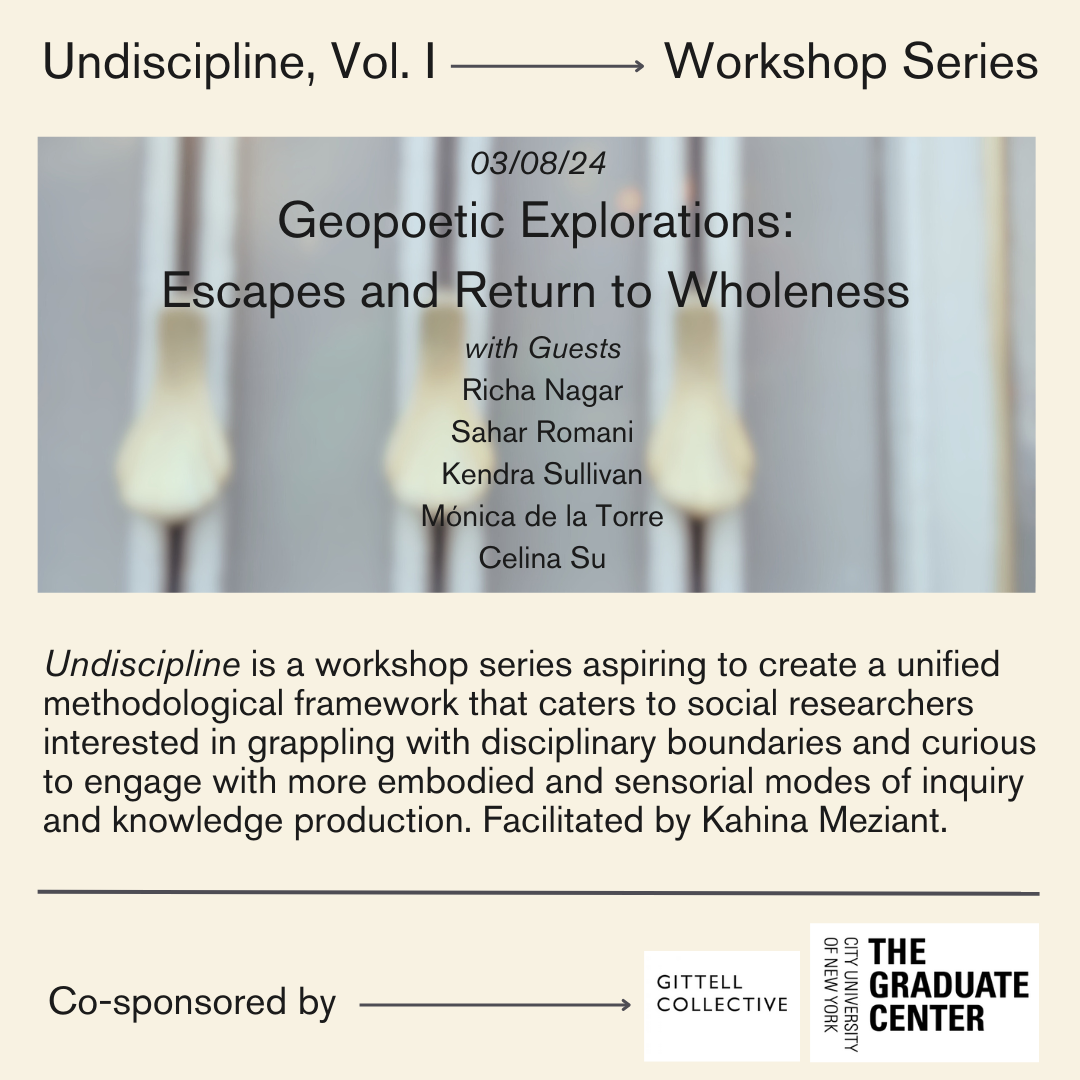
Event poster with the following text: Undiscipline is a workshop series aspiring to create a unified methodological framework that caters to social researchers interested in grappling with disciplinary boundaries and curious to engage with more embodied and sensorial modes of inquiry and knowledge production. Facilitated by Kahina Meziant.  Co-sponsored by the Gittell Collective and CUNY Graduate Center

2024 Book-Writing Workshop Awardees

The CUNY Gittell Collective Public Scholar Book-Writing Workshop supports CUNY faculty in developing and publishing great first books by providing structured feedback infrastructure: negotiated deadlines, peer camaraderie and accountability, and feedback from field/subfield experts and esteemed interlocutors.

The 2024 Awardees are:

  • Anthony Dest, Anthropology, Lehman College
    • Dissident Peace: An Ethnography of Struggle in Colombia
  • Ted Gordon, Music, Baruch College
    • The Composer’s Black Box: Cybernetics and Instrumentality in American Experimental Music
  • Rhea Rahman, Anthropology, Brooklyn College
    • Muslim Humanitarians in Black, Brown, and White: Racializing the Umma
  • Shreya Subramani, Anthropology, John Jay College of Criminal Justice
    • Carceral Transitions: The Productive Relations of Reentry Governance in New Orleans

CUNY Gittell Public Scholar Book Writing Workshop 2024

The CUNY Gittell Collective is launching a second year of its Public Scholar Workshop Program. It aims to provide CUNY faculty with the support and feedback infrastructures to write and publish great first books. We acknowledge that the resources provided by book workshops– negotiated deadlines, peer camaraderie and accountability, and feedback from field/subfield experts and esteemed interlocutors– are often informally distributed, inaccessible or intimidating for scholars from historically marginalized communities, or codified and available at only certain well-resourced universities. Up to three awardees will receive support to organize a virtual book workshop in summer 2024.

A $2,800 award will be used to provide four expert reviewers an honorarium for their participation in the workshops. This workshop aims to help CUNY faculty in political science, sociology, anthropology, urban studies, and related disciplines to advance book manuscripts.

We especially encourage applications from scholars who book projects focus on issues related to cities, social justice, community participation and development, political engagement and social movements, and democratic governance, both domestically and abroad, and/or those that draw upon some aspect of community-based research and related methodologies, with the aim of combining knowledge and action for policy or social change. This program was inspired by a Book Workshop project run as a partnership between John Jay College-CUNY, Howard University, and the University of Maryland, developed by Professors Niambi Carter (UMD) and Heath Brown (JJC CUNY). This version is sponsored by the Gittell Urban Studies Collective at the CUNY Graduate Center, co-led by Drs. Celina Su and Heath Brown, and co-coordinated/organized by Dr. Kahina Meziant (kmeziant@gc.cuny.edu). 

Eligibility

This workshop is designed for CUNY-affiliated faculty, whether full-time or part-time, who can share a completed draft of a first book manuscript by May 1, 2024. While applications from junior faculty (tenure-track or adjunct) will be prioritized, applications from senior faculty will also be considered if applicants 1. Wish to workshop their first book and 2. Agree to participate in a facilitated discussion mentoring junior faculty in the program. 

Timeline of meetings

Awardees will meet as a cohort, to share plans for their respective book projects, in late January 2024. A second potential meeting may take place around spring break; this meeting would be an opportunity for awardees to share a portion of an introduction or a book proposal and to receive some feedback. Awardees will meet with 4 reviewers in a virtual workshop to receive feedback on their book manuscript in June 2024.

Application deadline

11:59 pm on Monday, January 15, 2024. The application form is available here: https://forms.gle/1UR7dxurfxTfJeh7A

2023 Dissertation fellows

We are very pleased to announced the Gittell Dissertation Fellows for the 2023-2024 academic year:

Misty Crooks (Anthropology), Democracy Redefined: Electoral Governance, Political Demobilization, and the Hope of Reform Activism,

Silvina Calderaro (Urban Education), Regenerative Processes in Education and Climate Action: Learning More-than-human conviviality, and 

Marianne Madoré (Sociology), The Empire City’s university: A study of CUNY colleges’ imbrication in US imperialism in the early 21st century

Congratulations!

EVENT: Envisioning Social and Public Housing Futures, May 13th, 2023

Today housing insecurity is a generalized phenomenon, driving forward policy solutions under the guise of housing for all. As many look towards the future, they’ve looked past the fight to preserve public housing in growing favor of so-called “social housing” policy solutions. This half-day mini-conference will kick off with a conversation led by tenants leading the fight to preserve public housing in New York City. After they share their analysis of the current housing climate in NYC, an international panel of housing researchers will share comparative research and perspectives on public and social housing across cities in the US, the UK, Europe, Brazil and Canada.

This event is co-sponsored by the CUNY Graduate Center Gittell Collective, the Center for Place, Culture and Politics, and the Urban Studies Department at Queens College, CUNY.

Where and when: The People’s Forum. Saturday, May 13th. 11.30-2.30 pm.

2023 Book-Writing Workshop Awardees

The CUNY Gittell Collective Public Scholar Book-Writing Workshop supports CUNY faculty in developing and publishing great first books by providing structured feedback infrastructure: negotiated deadlines, peer camaraderie and accountability, and feedback from field/subfield experts and esteemed interlocutors.

The 2023 Awardees are:

  • John Frank (Sociology), Lehman College: The Self Illusion: A Simplified Equation for “You”
  • Marta-Laura Haynes (Anthropology), John Jay College of Criminal Justice, Untrusting: The quest for democratic policing in urban Brazil
  • Jinwon Kim (Sociology), College of Technology, The Koreatown in Manhattan: Branding Korea and Consuming Ethnicity in the Global Economy
  • Nerve Macaspac (Geography), College of State Island, Spaces Of Peace: How Ordinary People Protect Their Lives During War

CUNY Gittell Public Scholar Book Writing Workshop 2023

The CUNY Gittell Collective is launching its first Public Scholar Workshop Program. It aims to provide CUNY faculty with the support and feedback infrastructures to write and publish great first books. We acknowledge that the resources provided by book workshops– negotiated deadlines, peer camaraderie and accountability, and feedback from field/subfield experts and esteemed interlocutors– are often informally distributed, inaccessible or intimidating for scholars from historically marginalized communities, or codified and available at only certain well-resourced universities. Up to three awardees will receive support to organize a virtual book workshop in summer 2023.

A $2,000 award will be used to provide four expert reviewers an honorarium for their participation in the workshops. This workshop aims to help CUNY faculty in political science, sociology, anthropology, urban studies, and related disciplines to advance book manuscripts.

We especially encourage applications from scholars who book projects focus on issues related to cities, social justice, community participation and development, political engagement and social movements, and democratic governance, both domestically and abroad, and/or those that draw upon some aspect of community-based research and related methodologies, with the aim of combining knowledge and action for policy or social change. This program was inspired by the American Political Science Association’s Minority-Serving Institution Virtual Book Workshop project run as a partnership between John Jay College-CUNY, Howard University, and the University of Maryland, developed by Professors. Niambi Carter (UMD) and Heath Brown (JJC CUNY). This version is sponsored by the Gittell Urban Studies Collective at the CUNY Graduate Center, co-led by Drs. Celina Su and Heath Brown, and co-coordinated/organized by Dr. Kahina Meziant (kmeziant@gc.cuny.edu). 

Eligibility

This workshop is designed for CUNY-affiliated faculty, whether full-time or part-time, who can share a completed draft of a first book manuscript by May 1, 2023. While applications from junior faculty (tenure-track or adjunct) will be prioritized, applications from senior faculty will also be considered if applicants 1. Wish to workshop their first book and 2. Agree to participate in a facilitated discussion mentoring junior faculty in the program. 

Timeline of meetings

Awardees will meet as a cohort, to share plans for their respective book projects, in late January 2023. A second potential meeting may take place around spring break; this meeting would be an opportunity for awardees to share a portion of an introduction or a book proposal and to receive some feedback. Awardees will meet with 4 reviewers in a virtual workshop to receive feedback on their book manuscript in June 2023.

Application deadline

11:59 pm on Monday, January 16, 2023. The application form is available here: https://forms.gle/NN2Y7tm5jjxn2RJU6