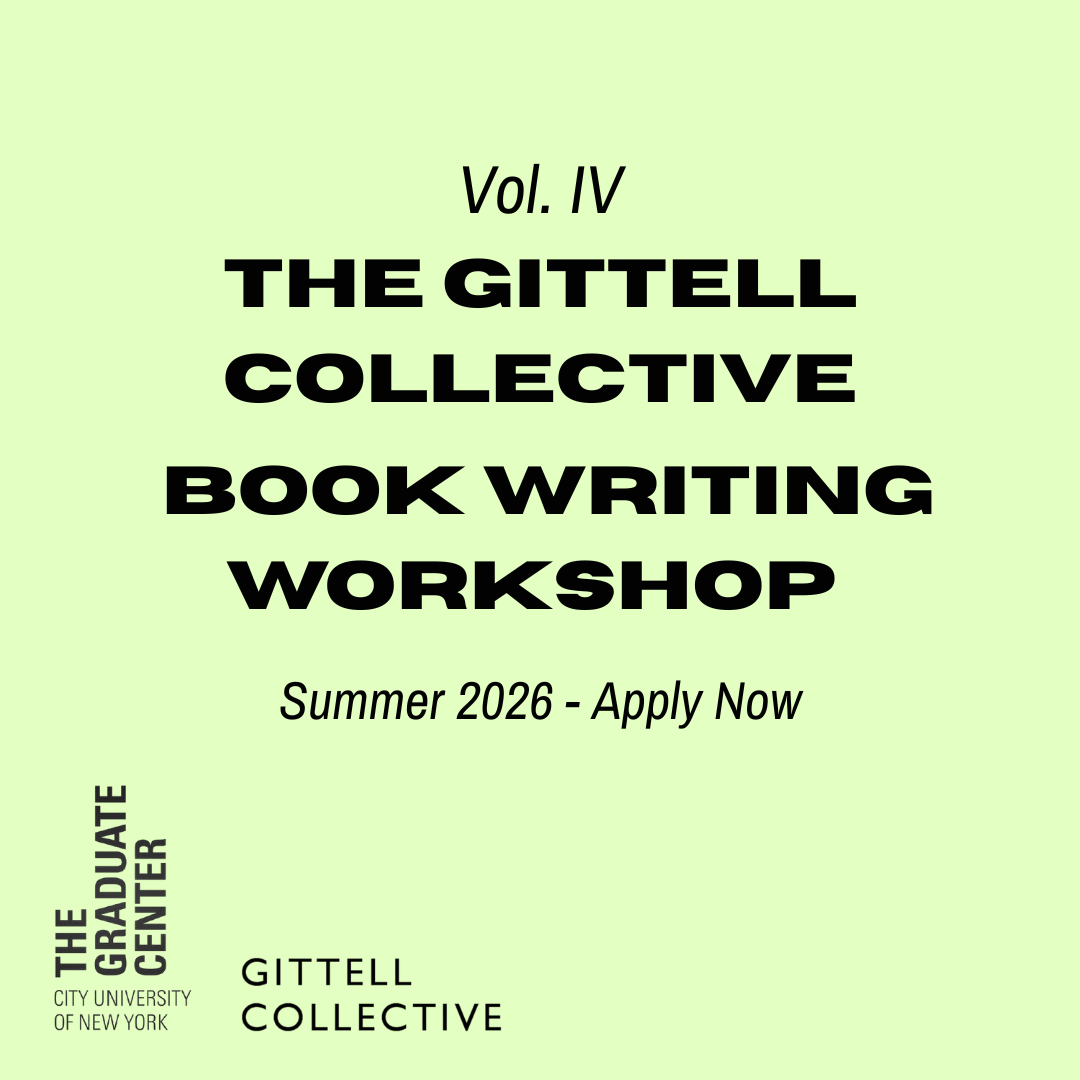
The CUNY Gittell Collective Public Scholar Book-Writing Workshop supports CUNY faculty in developing and publishing great first books by providing structured feedback infrastructure: negotiated deadlines, peer camaraderie and accountability, and feedback from field/subfield experts and esteemed interlocutors.
The 2026 Awardees for the Public Scholar Book-Writing Workshop are:
Xiaonan Wang, Political Science, Baruch College
The Politics of Appointing Insiders and Outsiders: Appointing Provincial Government Agency Heads in China
Lindsay Zafir, Women’s, Gender, and Sexuality Studies, Anthropology and Interdisciplinary Programs, City College
State of Denial: The AIDS Crisis and the Rise of the Disinformation Age
Andrew Amstutz, History, Queens College
Bound by Books: The Politics of Collecting & Lost Libraries in Muslim South Asia
Alexandra Stern, History, City College
Native Reconstruction: Indian Territory and the Making of the Modern American Power, 1861 – 1907
The CUNY Gittell Collective is launching a fourth year of its Public Scholar Workshop Program. It aims to provide CUNY faculty with the support and feedback infrastructures to write and publish great first books. We acknowledge that the resources provided by book workshops– negotiated deadlines, peer camaraderie and accountability, and feedback from field/subfield experts and esteemed interlocutors– are often informally distributed, inaccessible or intimidating for scholars from historically marginalized communities, or codified and available at only certain well-resourced universities. Three to four awardees will receive support to organize a virtual book workshop in summer 2026.
A $4,000 award will be used to provide four expert reviewers an honorarium ($1,000 each) for their participation in the workshops. This workshop aims to help CUNY faculty in political science, sociology, anthropology, urban studies, and related disciplines to advance book manuscripts.
We especially encourage applications from scholars whose book projects focus on issues related to cities, social justice, community participation and development, political engagement and social movements, and democratic governance, both domestically and abroad, and/or those that draw upon some aspect of community-based research and related methodologies, with the aim of combining knowledge and action for policy or social change. This program was inspired by a Book Workshop project run as a partnership between John Jay College-CUNY, Howard University, and the University of Maryland, developed by Professors Niambi Carter (UMD) and Heath Brown (JJC CUNY). This version is sponsored by the Gittell Urban Studies Collective at the CUNY Graduate Center, co-led by Drs. Celina Su and Heath Brown, and co-coordinated/organized by Dr. Selen Güler (sguler@gc.cuny.edu).
Eligibility
This workshop is designed for CUNY-affiliated faculty, whether full-time or part-time, who can share a completed draft of a first book manuscript by May 1, 2026. While applications from junior faculty (tenure-track or adjunct) will be prioritized, applications from senior faculty will also be considered if applicants 1. Wish to workshop their first book and 2. Agree to participate in a facilitated discussion mentoring junior faculty in the program.
Timeline of meetings
Awardees will meet as a cohort, to share plans for their respective book projects, in early February 2026. A second potential meeting may take place around spring break; this meeting would be an opportunity for awardees to share a portion of an introduction or a book proposal and to receive some feedback. Awardees will meet with 4 reviewers in a virtual workshop to receive feedback on their book manuscript in June 2026.
The CUNY Gittell Collective Public Scholar Book-Writing Workshop supports CUNY faculty in developing and publishing great first books by providing structured feedback infrastructure: negotiated deadlines, peer camaraderie and accountability, and feedback from field/subfield experts and esteemed interlocutors.
The 2025 Awardees for the Public Scholar Book-Writing Workshop are:
Simone Martin-Howard, Public Management, John Jay College of Criminal Justice
Conversations with Correctional Staff: Covid-19, Confinement, and Culture at Rikers Island Jail
Stephanie Boyle, History, College of Technology
Body and Soul: The intersection of Health and Spiritual Health in the Egyptian Delta 1854-1907
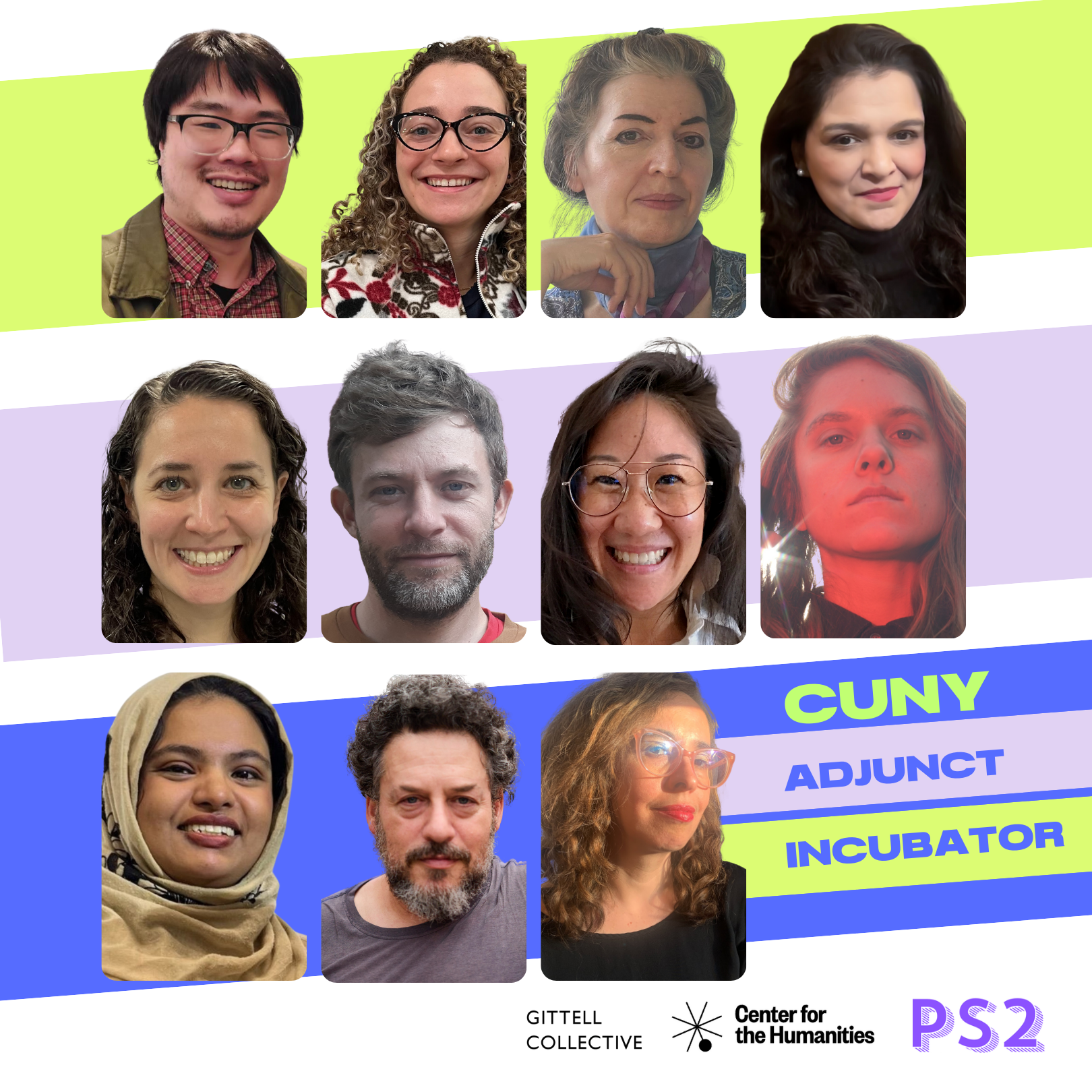
We are honored to announce the 2025 CUNY Adjunct Incubator Awardees. The projects represented here reflect just some of the creative, critical, and community-engaged work that is happening right now at CUNY. And this year, we have an unprecedented number of faculty awardees from our community colleges, showcasing the immense work across our 2-year, 4-year, and graduate schools. Faculty will embark on their projects in the summer of 2025, and we look forward to hearing more about their progress later next year.
Since 2019, the Gittell Collective and the Center for the Humanities at CUNY Graduate Center have honored the scholarly and creative work of our university’s adjunct faculty through the CUNY Adjunct Incubator. Now under the auspices of Public Scholarship Practice Space (PS2), the initiative continues to support and highlight the significant, critical and community-engaged scholarship and pedagogy work of adjuncts teaching across CUNY. Meet our 2025 Awardees and learn about their grant-funded projects and scholarship:
Tusia Dabrowska
Design, Queens College; Film, John Jay College
Tusia Dabrowska is a Polish American artist who works at the intersection of storytelling, performance and media. Tusia teaches courses in Design at Queens College and in Film and Videography at John Jay College.
“As a 2025 CUNY Adjunct Incubator awardee, I will continue to investigate the symbolic and political meaning of the newly erected border in the Białowieża forest. My research will focus on the refugee experience. This work will build toward a three channel, immersive iteration of ‘I No Longer Believe We Are Good People.’”
Seth Fein
Film, LaGuardia Community College
Seth Fein is a historian and filmmaker. He operates Seven Local Film, which he founded in Jackson Heights, Queens, where he lives. He teaches Film at LaGuardia Community College.
“My video essay will connect the lives and careers of Isamu Noguchi (1904-1988) and Joseph Cornell (1903-1972) across the borough in which they both lived and worked. Working between archival research and original footage, expository and participatory narration, ‘Noguchi and Cornell through Queens’ engages the past and present of place to consider each of these seminal-yet-outlier artists differently by contemplating their ‘outerborough’ worlds together.”
Naziat Hassan
Queensborough Community College
Naziat Hassan is a licensed mental health counselor at Queensborough Community College, with expertise in treating individuals, adolescents, adults, and families facing mood disorders, trauma, and substance abuse.
“As a 2025 CUNY Adjunct Incubator awardee, I will uplift underrepresented communities by raising awareness around mental health and well-being through culturally sensitive education, advocacy, and community outreach. By highlighting the unique challenges these populations face, I aim to create spaces for open dialogue, reduce stigma, and promote access to resources that support mental and emotional health.”
Diana Higuera-Cortés
Languages and Literatures, Lehman College
Diana Higuera-Cortes is a PhD student in the Latin American, Iberian, and Latino Cultures (LAILaC) program at the Graduate Center-CUNY. A former CUNY Humanities Alliance fellow, Diana teaches Spanish at Lehman College.
“As a 2025 CUNY Adjunct Incubator awardee, I will develop La Loteria Niuyorkina: A pedagogical game/toolkit to explore Spanish varieties though the Linguistic Landscape of New York City. The project will engage students from Lehman College and Queens College in the study of the public spaces they navigate everyday as well as an exploration of common Spanglish words and expressions that shape their identity.”
Alex Ho and Joy Liu
Department of Ethnic and Race Studies, Borough of Manhattan Community College (BMCC)
Joy Liu is a Therapist/ Clinical Social Worker. A former Museum educator, Joy now teaches in the Department of Ethnic and Race Studies at Borough of Manhattan Community College (BMCC).
Alex Ho is an ethnic studies and media arts educator with ten years of education experience and a film and media Alex teaches in the Department of Ethnic and Race Studies at Borough of Manhattan Community College (BMCC).
“As a 2025 CUNY Adjunct Incubator awardees, we will collaborate and explore family histories and cultural identities through a collaborative autoethnographic process of dialogue, artmaking, and oral history collection.”
Alice Kallman
Mina Rees Library, CUNY Graduate Center
Alice Kallman is an adjunct reference librarian in the Dissertation Office at the Mina Rees Library at CUNY Graduate Center. Over the course of studies, she worked at the New York Public Library, and then with an oral history project at the Queens Public Library. Alice also works part time at the Queens Public Library in the Correctional Outreach department doing reentry programming for individuals returning home from incarceration.
“As a 2025 CUNY Adjunct Incubator awardee, I will continue developing my ongoing project to document Syrian culinary superstitions. This will take the form of further interviews with Syrians in the diaspora – increasing my scope of research from just Syrian Jews to Syrians of all religions. I will also work on my website/digital archive that aims to hold the linkages within collected stories. Finally, I will use this funding to create a physical experience to display my findings, something between an exhibition, family meal, and immersive audio experience as guided by the research process.”
Jerald Isseks
Guttman Community College
Jerald Isseks is a critical educational scholar, an organizer and a writer who teaches in the First-Year Experience program at Guttman Community College.
“As a 2025 CUNY Adjunct Incubator awardee, I will continue developing a participatory research program for first-year students at Guttman Community College. Specifically, this will involve organizing a regular end-of-semester event where student researchers can present their work to the academic community, eliciting interest and support for action campaigns they’ve conceived to confront local and institutional issues of injustice.”
Hannah Weiss
Urban Planning and Policy, Hunter College
Hannah Weiss is an adjunct lecturer in Urban Planning and Policy at Hunter College.
“As a 2025 CUNY Adjunct Incubator awardee, I will collaborate with people who have navigated eviction and nonprofit attorneys striving to fulfill the promise of Right to Counsel (RTC). Through case studies and narrative, I hope to highlight the human element that is lost when data dominates eviction discourse, and light a fire under leaders to fund RTC and re-imagine housing court.”
Natalie Willens
LaGuardia Community College
Natalie Willens is an educator, artist, organizer, and Ph.D. candidate in Urban Education at the CUNY Graduate Center. They have published poetry, essays, and photography on the intersections of art and activism, and are working on a multi-year project with LaGuardia Community College students to creatively archive underfunded LGBTQ+ spaces in New York City.
“As a 2025 CUNY Adjunct Incubator awardee, I will work with students and community organizers to produce a public exhibition of our photographs and oral histories that highlight the essential work of underfunded LGBTQ+ spaces in New York City. The exhibition will have three main goals: To highlight the powerful collaborative work of CUNY students/faculty and community organizers, to respond to the ever-increasing erasure of LGBTQ+ spaces that serve the most marginalized members of the LGBTQ+ community, and to secure sustainable funding for the organizations that cultivate these life-saving spaces.”
Desislava Zagorcheva
LaGuardia Community College
Dessie Zagorcheva is an author and educator with a Ph.D. in International Relations from Columbia University. She teaches courses in Global Politics and American Government and Politics at CUNY. Her research focuses on global challenges to democracy. She is passionate about using her expertise to educate and inspire students to engage more actively in politics.
“As a 2025 CUNY Adjunct Incubator awardee, I will develop my project on enhancing Media Literacy Skills. This is a multidisciplinary project which has three main objectives first, to highlight the importance of media literacy and the challenges faced by educators in this field; second, to compile and make widely available best practices in media literacy instruction from various public colleges; and third, to create a comprehensive repository of resources for students, teachers, and librarians. By fostering media literacy and critical thinking we aim to cultivate a generation of well-informed citizens who can make sound decisions for themselves and their communities.”
The CUNY Adjunct Incubator is co-sponsored by PS2 at the Center for the Humanities through generous grants from the Sylvia Klatzkin Steinig Fund and the Gittell Urban Studies Collective at the Graduate Center, CUNY.
The CUNY Gittell Collective is launching a third year of its Public Scholar Workshop Program. It aims to provide CUNY faculty with the support and feedback infrastructures to write and publish great first books. We acknowledge that the resources provided by book workshops– negotiated deadlines, peer camaraderie and accountability, and feedback from field/subfield experts and esteemed interlocutors– are often informally distributed, inaccessible or intimidating for scholars from historically marginalized communities, or codified and available at only certain well-resourced universities. Up to three awardees will receive support to organize a virtual book workshop in summer 2025.
A $3,000 award will be used to provide four expert reviewers an honorarium for their participation in the workshops. This workshop aims to help CUNY faculty in political science, sociology, anthropology, urban studies, and related disciplines to advance book manuscripts.
We especially encourage applications from scholars whose book projects focus on issues related to cities, social justice, community participation and development, political engagement and social movements, and democratic governance, both domestically and abroad, and/or those that draw upon some aspect of community-based research and related methodologies, with the aim of combining knowledge and action for policy or social change. This program was inspired by a Book Workshop project run as a partnership between John Jay College-CUNY, Howard University, and the University of Maryland, developed by Professors Niambi Carter (UMD) and Heath Brown (JJC CUNY). This version is sponsored by the Gittell Urban Studies Collective at the CUNY Graduate Center, co-led by Drs. Celina Su and Heath Brown, and co-coordinated/organized by Dr. Kahina Meziant (kmeziant@gc.cuny.edu).
Eligibility
This workshop is designed for CUNY-affiliated faculty, whether full-time or part-time, who can share a completed draft of a first book manuscript by May 2, 2025. While applications from junior faculty (tenure-track or adjunct) will be prioritized, applications from senior faculty will also be considered if applicants 1. Wish to workshop their first book and 2. Agree to participate in a facilitated discussion mentoring junior faculty in the program.
Timeline of meetings
Awardees will meet as a cohort, to share plans for their respective book projects, in late January 2025. A second potential meeting may take place around spring break; this meeting would be an opportunity for awardees to share a portion of an introduction or a book proposal and to receive some feedback. Awardees will meet with 4 reviewers in a virtual workshop to receive feedback on their book manuscript in June 2025.
Call public attention to adjuncts’ valuable contributions at CUNY;
Support CUNY adjuncts and their teaching, scholarly, creative, and activist work;
Promote their arc toward professional success and economic well-being; and
Advocate for more paid, full-time, tenure-track positions for adjuncts to advance toward.
We will award $4,000 each to ten CUNY adjuncts developing independent scholarship and/or public projects in the humanities or humanities-related social sciences. Scholarship and/or public projects to be completed during the summer of 2025.
DEADLINE:
Sunday, October 27, 2024 by 11:59 pm
WHAT:
For this cycle, we wish to prioritize community-facing and -building work, broadly construed. Project focus might include (but not limited to): public education (especially CUNY), public health, housing, labor, liberation movements.
Our rubric for evaluation is as follows:
Public engagement: Does this project demonstrate a deep awareness of the reciprocal methods, ethics, and goals of community-oriented practice? Does it consider the compensation of communities in which it engages, and provide a robust grasp of existing research and genealogies of its subject of study?
Urgency: Does this project address an emergent social (environmental, health, educational, etc.) need in meaningful ways?
Creativity: Does the application think about an intellectual or practical problem through a previously unexamined perspective or with an innovative set of tools?
Feasibility: Does the project seem manageable and are we the right organization to help the applicant fulfill their goals in a rich and nuanced way?
In addition to covering costs associated with scholarly research, this grant can support travel related to professional and/or curriculum development, and research and development of a public-facing project such as: archival research, oral histories, digital/interpretative platforms, online or print publications, performances, and panels, conferences, and exhibitions, etc. The scholarship work and/or public projects are to be completed during the summer of 2025. For examples of past grant-funded projects, visit 2021 projects here, 2020 projects here, and 2019 projects here):
ELIGIBILITY:
Current adjuncts at any CUNY College.
*Please note that if you are a current doctoral fellow at The Graduate Center, CUNY who also holds adjunct position/s, before applying, please contact the Office of Financial Aid at financialaid@gc.cuny.edu to ensure that receiving this grant will not adversely impact your existing award package.
EXPECTATIONS:
You will be in charge of managing your research or project, from conception to completion. This includes managing the budget e.g. honoraria for community participants and others, and any taxes i.e. deduct 33%
We request a blog post about your project and a brief, one-page, narrative report on research progress and impact by September 12, 2025.
We invite recipients to think about sharing their work with wider publics and welcome proposals for public panels or online events related to your work.
APPLICATION:
Fill out the application form, and upload as a single PDF file to the form (name your file as follows LASTNAME_FIRSTNAME_CAI2025):
a one-page letter of interest (which can include a description of your research or public project, a timeline, and your methodological tool-kit),
Recipients will be decided by an interdisciplinary advisory committee. The 2025 CUNY Adjunct Incubator Advisory Committee is comprised of Celina Su, Dasharah Green, Kendra Sullivan, Mary N. Taylor, Prithi Kanakamedala, and Ujju Aggarwal.
For any queries, reach out to Prithi, PS2 faculty coordinator ps2@gc.cuny.edu
The CUNY Adjunct Incubator is co-sponsored by PS2 at the Center for the Humanities through generous grants from the Sylvia Klatzkin Steinig Fund and the Gittell Urban Studies Collective at the Graduate Center, CUNY.
About the Gittell Urban Studies Collective: The Gittell Urban Studies Collective engages communities, fellow scholars, and activists focused on issues related to cities, social justice, community participation and development, political engagement and social movements, and democratic governance, both domestically and abroad. Read more here
About the Center for the Humanities at The Graduate Center, CUNY: The Center for the Humanities at the CUNY Graduate Center encourages collaborative, creative, and engaged work in the humanities and social sciences. While providing students, faculty, and community partners with grants, fellowships, and professional support, we also produce innovative projects and programs, digital and print publications, and infrastructure for public scholarship from a justice-forward framework at CUNY and across NYC. Read more here.
We are pleased to announce the 2024 Gittell Dissertation Fellows:
Ryan Brunette (Political Science), After the Miracle: Constructing Political Regimes and Corruption in Post-Apartheid South Africa
Thayer Hastings (Anthropology), Inhabiting the “Center of Life” in Jerusalem and the Demographic Governance of non-Citizenship
Zahra Khalid (Earth and Environmental Sciences), The “military real-estate state:” insecurity, middle-class aspirations, and speculative real-estate development in Pakistan
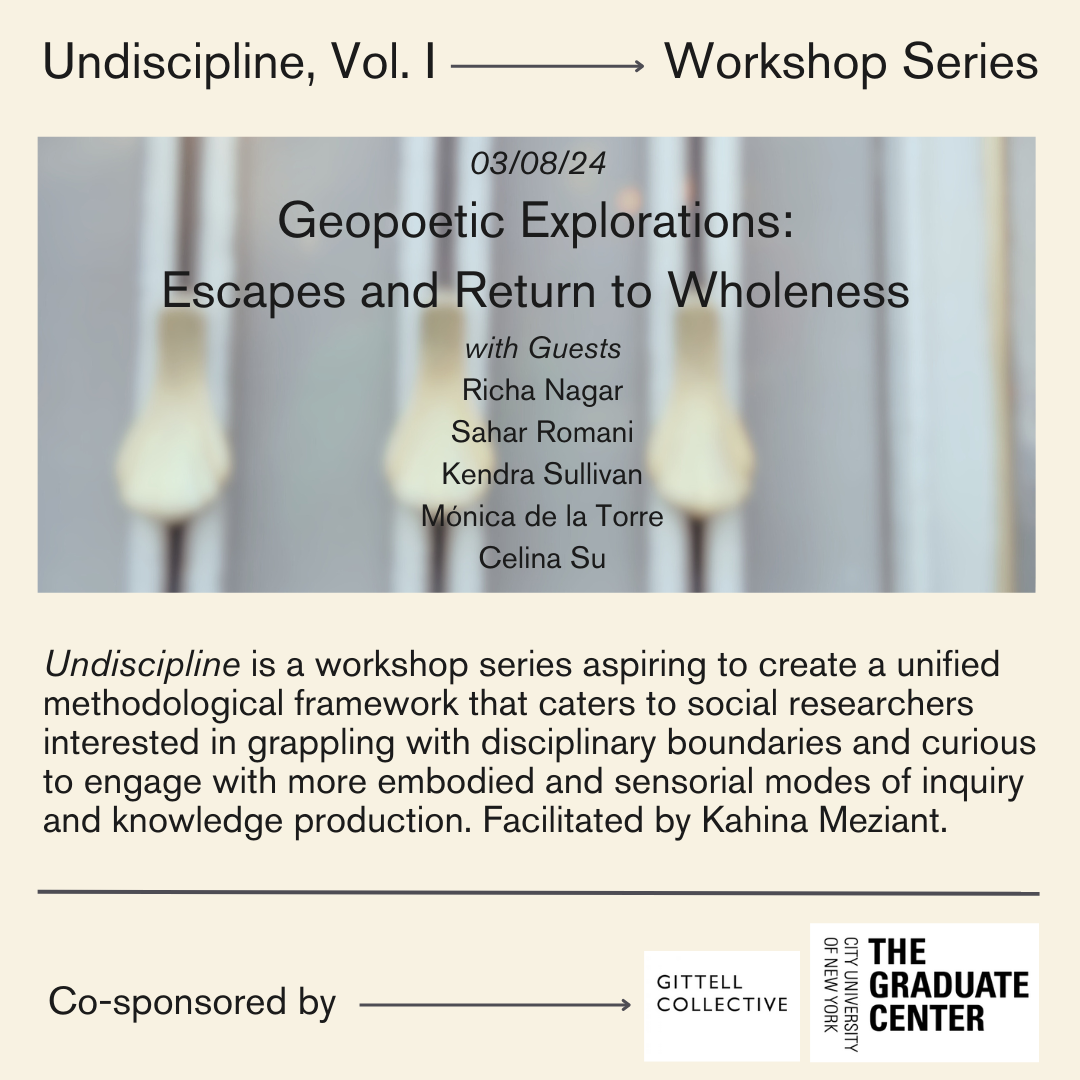
The Geopoetics workshop series consisted of four convenings between September 2023 and April 2024. It brought together poet-scholars and early career researchers to practice geopoetics as a living methodology at the intersection of the humanities and social sciences, keeping in mind questions of epistemic justice. Across the series, participants worked with pieces of empirical data in hand (objects, transcripts, field notes, spreadsheets) through specific writing exercises and the exquisite corpse method, in order to practice collective qualitative methods. By spending time with one another’s data, participants practiced what it means to hold research as collective rather than proprietary, experimental rather than fixed, to surface new themes and conversations across datasets.
Feminists and postcolonial scholars–from Saidiya Hartman’s critical fabulation to Christina Sharpe’s atmospheric writing, Kathleen Stewart’s attunement to the ordinary–have long shown that the manner in which we gather information through the research process is not always conscious. Much happens just below the surface of awareness in the relations we establish during fieldwork.
The series began in in September 2023 with an exploratory Zoom session among poet-scholars—Sahar Romani, Monica de la Torre, Richa Nagar, Celina Su, and Kendra Sullivan—working at the intersection of the humanities and social sciences with an epistemic justice orientation. By March 2024, the group reconvened in person to write with data together, treating geopoetics as affective attunement: listening across languages, disciplines, and positions, allowing multiple voices to compose what no single author could write alone.
In parallel, two additional encounters convened PhD candidates in Human Geography and Environmental Psychology interested in similar questions from within their disciplinary training—Anna Schlenz, Simone Parker, Irina Shirobokova, Clairette Atri, and Natalia Lara Gonzalez. Through collaborative mapping and creative constraints, we explored how arbitrary rules–when acknowledged rather than naturalized–can generate new ways of seeing, and how disassembling academic forms must be paired with reassembling them into something new.
The final convening in April deepened these threads around generative bounds and language as world-making, drawing on Erin Manning’s “minor gestures”—the smallest movements that transform how language is experienced and enacted. Participants proposed continued explorations of embodied methods going forward: participatory mapping, choreographic inquiry, and creative constraints as guides rather than restrictions.
 Gittell Collective